
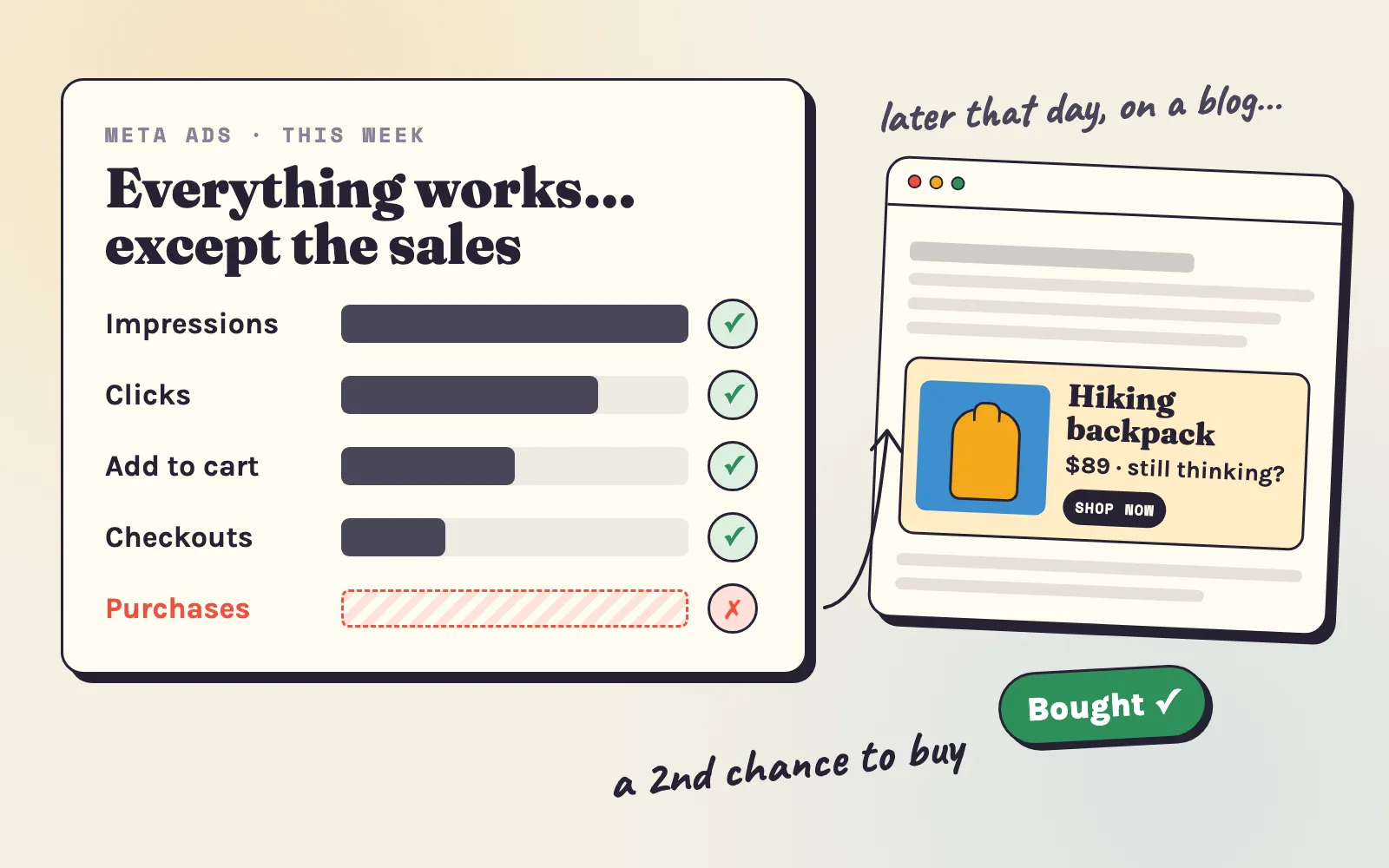
The ads still run. People still click. They even add to cart and start checkout. And then nothing. If that is your Ads Manager this month, you are in good company: “Lots of add to carts from Meta ads but where are the orders?” is a Shopify Community thread from October 4, 2026, and the ad forums are full of variations of it.
This guide does three things. It lists what really changed on Meta in 2026, with dates and sources. It gives you a way to find which change hit your store. And it shows the fix most stores skip: a second chance to buy for the shoppers who don’t buy on Meta.
What are merchants seeing in October 2026?
The reports fall into a few patterns:
- Carts but no orders. Impressions and clicks look normal, add-to-carts and checkouts come in, purchases stay flat.
- Cheap but empty traffic. One advertiser reported a CPM that fell by about 80% while the click-through rate dropped from 2.5–3% to about 0.5% and add-to-carts fell to zero (October 2026 changelog).
- Suddenly expensive. Others saw CPMs almost double within a few weeks (same source).
- ROAS down, orders not. Ads Manager shows fewer purchases than the store actually received.
These look like one problem, but they break the sale at different steps. That matters, because each step has a different fix.
Did Meta change something in October 2026?
Short answer: Meta has not announced one big change. What happened is a pile-up of smaller changes through 2026. Each one moves a number a little, and together they make the same ads look worse - on top of the usual quiet month before Black Friday. Here they are in order.
- A new way of matching ads to people goes fully live.Delivery Meta now picks ads by their creative more than by your audience settings. In a study of 3,014 e-commerce advertisers, ROAS fell 7% on average during the rollout, and 31% for the best-performing third (Confect).
- 7-day-view and 28-day-view conversions are no longer reported.Counting A sale more than a day after someone only saw your ad no longer shows up as a conversion (PPC Land).
- Shopify's app pixels switch to "Optimized" data sharing.Counting Shopify can pause a pixel it thinks sends too little signal, without telling you (Analyzify).
- A click-through conversion now needs a link click.Counting Sales after a like, share or save moved to a separate one-day "engage-through" window (Jon Loomer).
- Ads cost more.Cost Meta's second-quarter report: the average price per ad was up 12% year on year, with 14% more ad impressions (Meta 10-Q).
- Placement exclusions disappear from Sales ad sets.Delivery You can lower the bid for a placement, but you can no longer block it in the ad set (Jon Loomer).
- Meta launches Muse, a shopping agent that can check out for people.Shopping Shopify product catalogs are shared with it by default. A purchase made by an agent can skip your ad completely (Big Flare).
- About 90 minutes of ad delivery outage.Delivery The only incident on Meta's status page in that period (AdsUploader).
- A delivery bug on Instagram, according to Meta support.Delivery In a support message that advertisers shared on X, Meta says that a recent change made its system data stale, so it estimated click-through rates wrongly for some Instagram ads, and that this "may have affected how those ads were optimized and delivered". Fixed on October 10 at 11:21 AM PDT. It is not on Meta's public status page.
- US consumer sentiment falls to a five-month low.Demand The University of Michigan index came in at 46.3 (preliminary), down from 48.1 in September (Advisor Perspectives).
- Product browsing switches on for running ads unless you opt out.Delivery A tap can open a product page inside Facebook or Instagram instead of your store. Meta says it brought 3% more conversions in a test (PPC Land).
Three of these change only what Meta counts, not what you sell. Two change who sees your ads and where. One makes every impression more expensive. And the calendar adds one more: in October, many shoppers put items in a cart and wait. In BCG’s 2025 survey of more than 10,000 shoppers in 10 countries, 77% said they delay purchases earlier in the year to buy them in Black Friday promotions.
Why do add-to-carts not turn into orders? Six likely causes
If you are new to Meta ads, go through this table from the top - the first two causes cost nothing to check. If you run ads for a living and did all of this in the first week, skip to Checked everything and still no sales?
| Cause | What you see | How to check |
|---|---|---|
| 1. Meta counts fewer sales | Shopify orders steady, Meta purchases down | Compare Shopify orders (all channels) with Meta purchases, week by week |
| 2. Tracking gap | Add-to-carts are tracked, purchases are missing | Place a real test order and watch Events Manager > Test events |
| 3. Weaker delivery | CPM down, click-through rate down, carts from odd placements | Break results down by placement and by device |
| 4. Tired creative | Frequency above 3 a week, click-through rate down 20% or more | Frequency column in Ads Manager, week over week |
| 5. Checkout friction | Many checkouts started, few finished | Shopify > Orders > Abandoned checkouts, and a test purchase on your phone |
| 6. Shoppers waiting | Carts saved, no orders, more wishlist adds | Normal for October. Plan how you will reach these people in November |
1 and 2: is it a counting problem?
Open Shopify Analytics and Ads Manager side by side for the last four weeks. If your total orders held up while Meta’s purchases fell, you have a counting problem, not a sales problem. Judge Meta by your blended numbers instead:
Blended ROAS = total store revenue ÷ total ad spend on all channels. If it is stable, your ads still work - the report just credits fewer of the sales to Meta. Our ROAS calculator shows your break-even point.
Then close the gaps. In Shopify, go to Settings > Customer events > App pixels and set the Facebook & Instagram pixel’s data sharing to Always on. In the Facebook & Instagram app, use Maximum data sharing, which sends purchases from the server and does not depend on the browser. Remove any second Meta pixel pasted into your theme - duplicate pixels inflate add-to-carts.
3 and 4: is Meta showing your ads to the wrong people?
Meta now matches ads to people mostly by the creative itself. Near-identical ads are grouped and treated as one, so ten versions of one video do not give you ten chances. Ads also wear out faster - agencies now talk about 2–4 weeks instead of 6–8. If frequency climbs and click-through rate falls, you need new concepts, not new variants: a customer video, a product demo, a comparison, an offer.
Cheap traffic is the other warning sign. If CPM fell sharply but sales fell with it, the money moved to placements where people tap but rarely buy. Since placement exclusions left Sales ad sets, the lever left is to bid down a placement, or to exclude it once for the whole ad account.
5 and 6: is the store, or the season, holding the sale back?
About 70% of carts are abandoned across e-commerce, and extra costs at checkout are the most common reason. Show shipping costs on the product page, offer Shop Pay, PayPal and Apple Pay, and buy something from your own store on your phone once a month.
If everything checks out and carts still sit there, the shoppers are probably waiting for a deal. That is not lost money - it is November’s money, if you can reach those shoppers again.
Checked everything and still no sales?
Many experienced advertisers did all of the above in the first week. Pixel and server events match, test orders go through, the checkout converts other traffic as before - and Shopify orders from Meta are still down. Then the cause is not your store, and “check your checkout” is not advice you need. This is what is worth doing when the problem is on Meta’s side.
Find out whether your account was hit by the October 8–10 bug. Advertisers shared this message from Meta support on X:
“On October 8, 2026, we discovered an issue in our ads delivery system that may have caused our system to incorrectly estimate click-through rates for some ads on Instagram, which may have affected how those ads were optimized and delivered. […] The issue was resolved on October 10, 2026, at 11:21 AM PDT.”
The incident is not on Meta’s public status page, so the only way to know whether your ads were affected is to ask. Open a support chat, quote the dates and the time Meta gave, and ask whether your ad account was affected and whether a credit applies. Meta has refunded advertisers after ad bugs before, but there is no promise of one this time.
Take the bad days out of your numbers. Leave October 8–10 (and the September 22 outage) out of every comparison. Don’t use those days to decide a creative test or which ads to switch off. If you paused a winning ad that week, test it again.
Look at where the money went, not only at the total. The estimated click-through rate helps decide which of your ads gets each impression, and where. Compare spend by ad and by placement for October 1–7, 8–10 and the days after. If spend moved to ads or placements that never sold before, give it a few clean days. If it does not move back, turn off the ads that took the money and never sold, so the budget returns to the ones that did.
Compare with last October, not with last month. Pull your Shopify sales for September and October 2025. If last October also dropped, part of this one is the season. Judge on blended numbers - total revenue divided by total ad spend - over four to eight weeks, not on the attribution in Ads Manager.
Don’t spend more to fix it. More budget in an unstable auction buys expensive impressions, and rebuilding the account restarts learning a month before Black Friday. Keep the campaigns that sold, lower Meta’s budget to where your blended numbers break even, and move the rest to channels that close the sale - retargeting outside Meta, email, search.
If you spend enough, measure lift instead of attribution. A conversion lift study in Ads Manager, or a simple holdout - pause Meta in one region for two weeks and compare it with the others - shows what Meta really adds to your sales, whatever Ads Manager reports.
Should you stop running Meta ads?
Usually not. Meta is still where many sales start. In our sample of 28 Shopify stores, Facebook or Instagram was the first visit in 9 of 10 orders it was part of. Switch it off and you cut off the shoppers that every other channel would later close.
The better question is what happens after the first click.
The sale usually happens on the second visit
We looked at the customer journey Shopify records for each order - every visit to the store before the purchase, and where it came from.
This is where 2026 hurts. When the second touch gets more expensive or less reliable on Meta - higher prices, fewer people Meta can track back to your store, broad delivery that mixes new and returning shoppers - the 4 in 10 orders that needed Meta to bring the shopper back are the ones at risk. Your first-touch ads may be as good as ever. The return trip is what broke.
So the fix is not only “better Meta ads”. It is making sure the way back to your store does not depend on one app.
People don’t spend the whole day on Facebook and Instagram
Online adults spend a little over an hour a day on social networks like Facebook and X, and more than 2.5 hours with video platforms like YouTube and TikTok included, out of roughly 33.5 hours a week of online media (DataReportal, Digital 2026). The rest of the time they read blogs and news, look up reviews, browse other stores and play games on their phone. A shopper who left your cart on Instagram at 8 am is very likely somewhere else at 9 pm.
- InstagramSees your ad for a hiking backpack, taps, adds it to the cart. The train arrives and the phone goes away.
- BlogReads a hiking blog at lunch. Your backpack is in an ad block below the article.
- Another storeLooks at boots in another online store. Your backpack appears under "You may also like".
- InstagramScrolls for ten minutes. Your ad does not come up - the auction went to someone else tonight.
- Mobile appPlays a puzzle game, sees the backpack again, taps it and buys.
How retargeting on the open web closes the sale
Display retargeting shows a shopper the products they looked at in your store, later, on other websites and apps they use. The ads appear in other online stores (on product pages, in the cart, on thank-you pages), on blogs, niche and expert websites, forums, and in mobile apps. The ad is your own product - photo, name and price.
It works next to Meta, not instead of it:
- It catches shoppers where Meta can’t - in the hours they are not scrolling a feed.
- It is built on your own store’s visitors, so it does not depend on Meta’s audiences, its tracking or its auction prices.
- It is cheap per view, so the shopper can see your product a few times before buying.
What we measure across Adeagle stores:
- Retargeting ads are clicked 6 to 12 times more often than ads shown to new shoppers (August–September 2026).
- One example: a US store selling electrical supplies, about 60 orders a month, on our smallest plan with retargeting switched on for a test. Over seven months it paid $204, and its ads brought 10 orders worth $5,830 - a 28.6× ROAS, every order after a click on a retargeting ad.
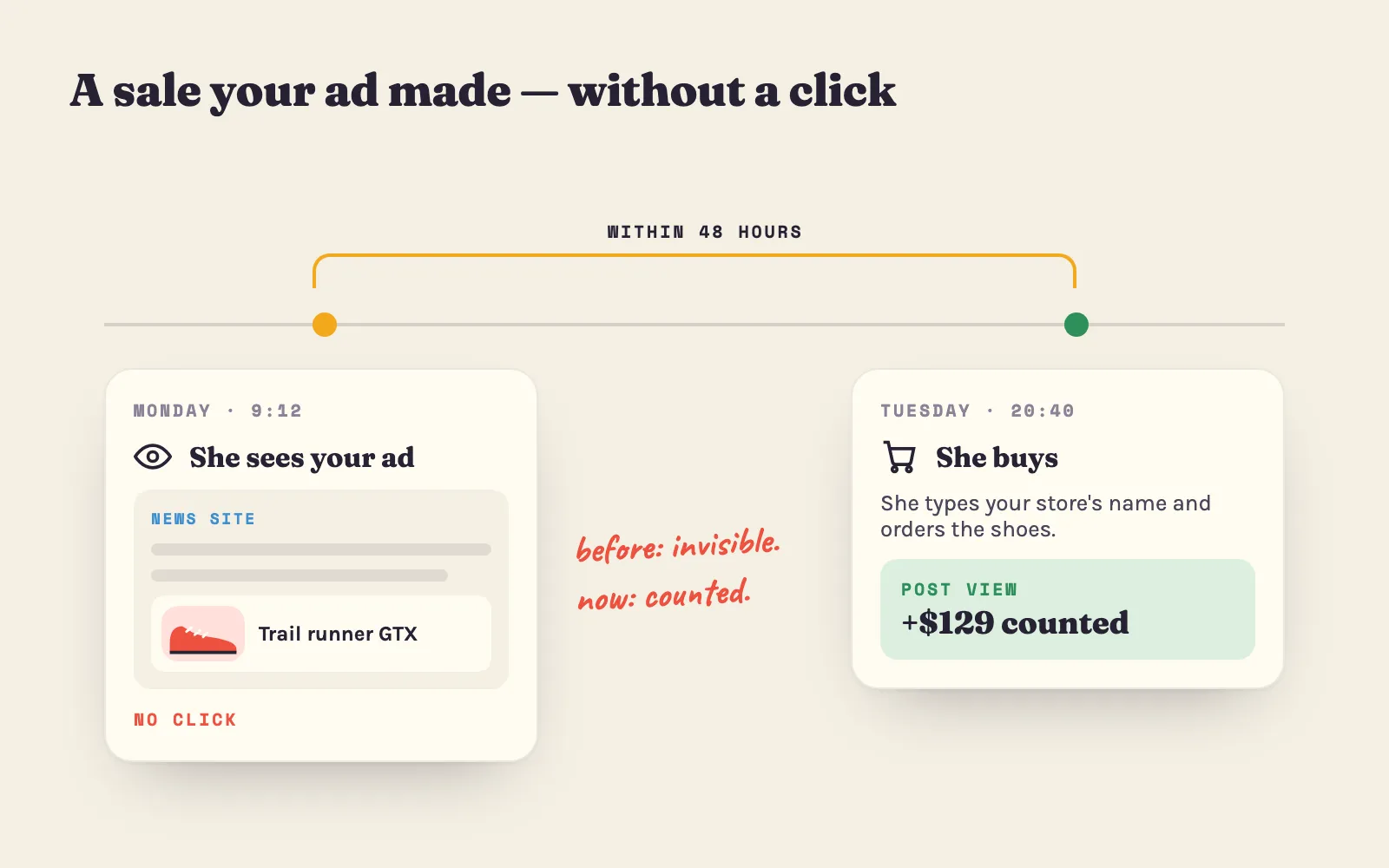
- Not every sale comes from a click. Many shoppers see the product, remember it and come back by typing your store’s name. Adeagle counts those as post-view conversions, next to post-click sales.
Adeagle is the Shopify app that does this. It turns your products into ads in every common banner size, shows them to shoppers interested in your product categories, and - on the plans with retargeting - brings back visitors who left without buying. Nothing in your Meta setup changes. See the plans.
A 7-day plan to rescue October
- Day 1Count the real salesShopify orders against Meta purchases for the last four weeks. Work out your blended ROAS, and mark October 8–10 as unreliable.
- Day 2Fix trackingOne Meta pixel only, data sharing "Always on" in Shopify, "Maximum" in the Facebook & Instagram app. Test with a real order.
- Day 3Buy from your own store on a phoneShipping costs visible early, express payment buttons, no surprise fees. Read the abandoned checkouts report.
- Day 4Make new concepts, not new variantsThree to five ads that really differ: a customer video, a demo, a comparison, an offer.
- Day 5Decide on product browsing before October 28Opt out if you want every click on your own store, or keep it on one campaign and compare.
- Day 6Catch the shoppers who waitAbandoned-cart emails and SMS, an early-access Black Friday list, a reason to buy now - a bundle or a free-shipping threshold.
- Day 7Add a channel that brings visitors backRetargeting on other websites and apps, Google Shopping for people who search, email flows. Judge it after 2 to 4 weeks.
Which channels to add next to Meta
| Channel | Best for | Effort to start | Needs Meta’s data? |
|---|---|---|---|
| Display ads and retargeting on other websites and apps (Adeagle) | Bringing visitors back; reaching shoppers by interest | Low - the ads are made from your products | No - built on your store’s visitors |
| Google Shopping and Search | Shoppers already searching for your product | Medium - product feed and bids | No |
| Email and SMS flows | Abandoned carts and checkouts, repeat buyers | Low to medium | No |
| Planned purchases: home, fashion, gifts, weddings | Medium | No | |
| TikTok | Discovery through video | High - needs new videos all the time | No |
| Creators and customer videos | Trust, and new creative for every channel | Medium | No |
You don’t need all six. For most small stores, one channel that finds shoppers (Meta) plus one that brings them back (retargeting or email) covers the biggest gap. Our CPC calculator and CPA calculator help you compare what a visitor and an order cost on each.
What to expect in November
Black Friday week makes every impression more expensive. In 2025 the median brand in one analytics company’s data paid 59% more per 1,000 Meta impressions in Black Friday week than in September - but its cost per purchase fell 20%, because so many more people were ready to buy (Lebesgue).
That is the good news hidden in a slow October: many of the carts left this month are sales waiting for a reason. Stores that can reach those shoppers again in November - on Meta and away from it - collect them. Stores that rely on one expensive auction to bring everybody back will pay the most for the same orders.
Sources
- Merchant reports: Shopify Community, October 4, 2026; Meta ads changelog, October 2026
- Counting changes: PPC Land on attribution windows; Jon Loomer on link-click attribution; Analyzify on Shopify app pixels
- October 8–10 delivery bug: Meta support message, shared on X (no public Meta statement found); Fortune on Facebook’s 2017 refunds to advertisers
- Delivery and price: Confect Andromeda study; Jon Loomer on placement controls; Meta Q2 2026 10-Q; PPC Land on product browsing
- Shoppers: DataReportal, Digital 2026; BCG Black Friday survey 2025; cart abandonment statistics 2026; University of Michigan sentiment, October 2026; Lebesgue on Black Friday CPMs
- Adeagle data: Shopify customer journeys and ad results from stores using Adeagle, as described under each figure
Questions
Usually a mix of four things - shoppers saving items and waiting for Black Friday, friction at checkout (surprise shipping costs, missing payment methods), cheaper but weaker ad delivery, and purchases that happen but are not counted. Compare your Shopify orders with the purchases Meta reports before you change any ad.
According to a Meta support message that advertisers shared on X, an issue in Meta's ad delivery made the system estimate click-through rates wrongly for some Instagram ads, which affected how those ads were delivered. Meta found it on October 8, 2026 and says it was fixed on October 10 at 11:21 AM PDT. It is not on Meta's public status page, so ask Meta support whether your ad account was affected.
Meta has announced no single change. Through 2026 it changed how conversions are counted (January and March), how ads are matched to people and placements, and ad prices rose 12% year on year by the second quarter. Product browsing switches on for existing ads on October 28 unless you opt out.
Not before you check counting and checkout. In our sample, Facebook or Instagram was the first visit in 9 of 10 orders it was part of - switch it off and you lose the shoppers every other channel would close. Lower the budget to what you can afford, keep your best creative, and add a channel that brings visitors back.
At least 7 days after a big change to budget, audience or creative, because each one restarts Meta's learning. Judge results on 2 to 4 weeks of blended numbers - total sales divided by total ad spend - not on one day in Ads Manager.
There is no single replacement. Most small stores do best with a mix - Google Shopping for people searching for the product, email and SMS for people who left an address, and display ads with retargeting on other websites and apps to bring visitors back. Adeagle does the last one inside Shopify.
Yes. It is built on the visitors of your own store, so it does not depend on Meta's audiences or tracking. In our data, retargeting ads were clicked 6 to 12 times more often than ads shown to new shoppers.