
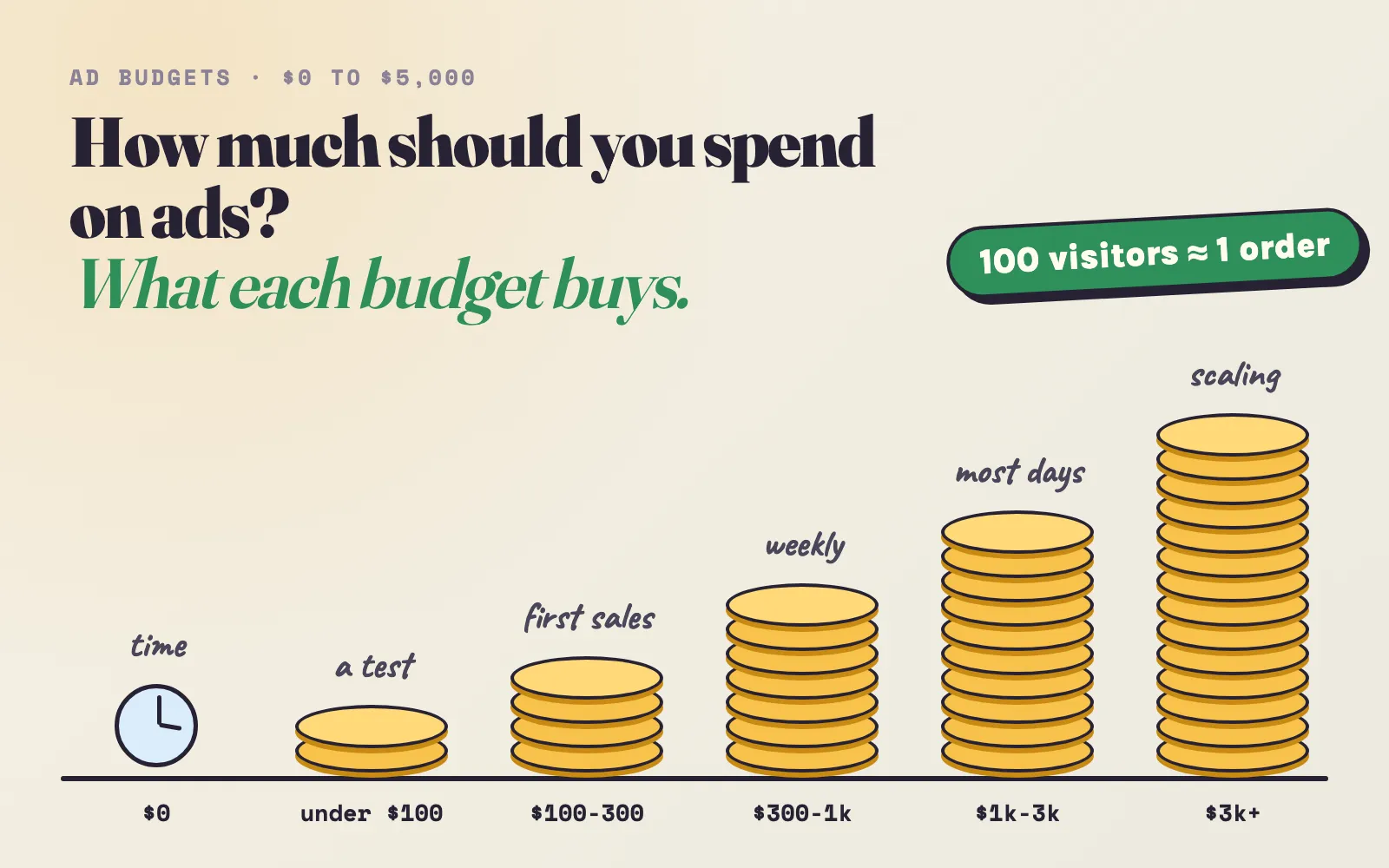
“How much should I spend on ads?” is the first question almost every new store owner asks - and the hardest one to answer without any sales yet. Once a store has sold for a few months, its own numbers say what a sale costs. Before that, you need to estimate.
This guide does the estimate for you. It shows how a budget turns into visitors and orders, what each ad channel costs in 2026, and what you can realistically expect at every budget from $0 to $5,000 a month. It also shows what we see in real Shopify stores: how many visits a sale takes, how long the first order from the ads takes, and what a few stores spent before their first sales came.
The short answer
- $0Time instead of moneyFree channels - Google listings, short videos, Pinterest, communities, email. Visitors come slowly, over months.
- Under $100A test, not a campaignUp to about 125 visitors on Facebook and Instagram. A first order is possible; you learn whether people click.
- $100-300The first salesAbout 125-380 visitors - roughly one to four orders a month at a 1% conversion rate.
- $300-1,000Weekly salesAbout 380-1,270 visitors - four to thirteen orders, enough to compare two or three campaigns.
- $1,000-3,000Orders most daysAbout 1,270-3,800 visitors - thirteen to thirty-eight orders. Now profit per order decides.
- $3,000 and moreScalingEnough purchases for the big platforms' systems to learn. Grow in steps of 20-30%.
The rest of this guide explains where these numbers come from, so you can redo them for your own store.
From budget to orders: the math
Every ad budget goes through the same three steps: money buys views, some views become visitors, some visitors become orders.
$200 a month on Facebook and Instagram at about $0.79 a visitor buys about 253 visitors. At a 1% conversion rate that is about 2.5 orders a month.
Which conversion rate to plan with? The median Shopify store turns 1.3% of its sessions into orders, the top 20% pass 2.7% and the top 10% pass 3.6% (Littledata, 438 stores, August-October 2026). But that average includes returning customers, email and people who typed the store’s address. First-time visitors convert at a median 0.91%, returning visitors at 2.68% - almost three times as often (Top Growth Marketing, 33 DTC stores, 2025-2026). A new store’s ad traffic is almost all first-time visitors. So plan on 1%: one order per 100 visitors. If your store turns out better, every number in this guide gets better too.
How many visitors does the first sale take?
On average, 100. But orders arrive at random, so 100 visitors bring no order at all more than a third of the time. This is how likely at least one order is at 1%:
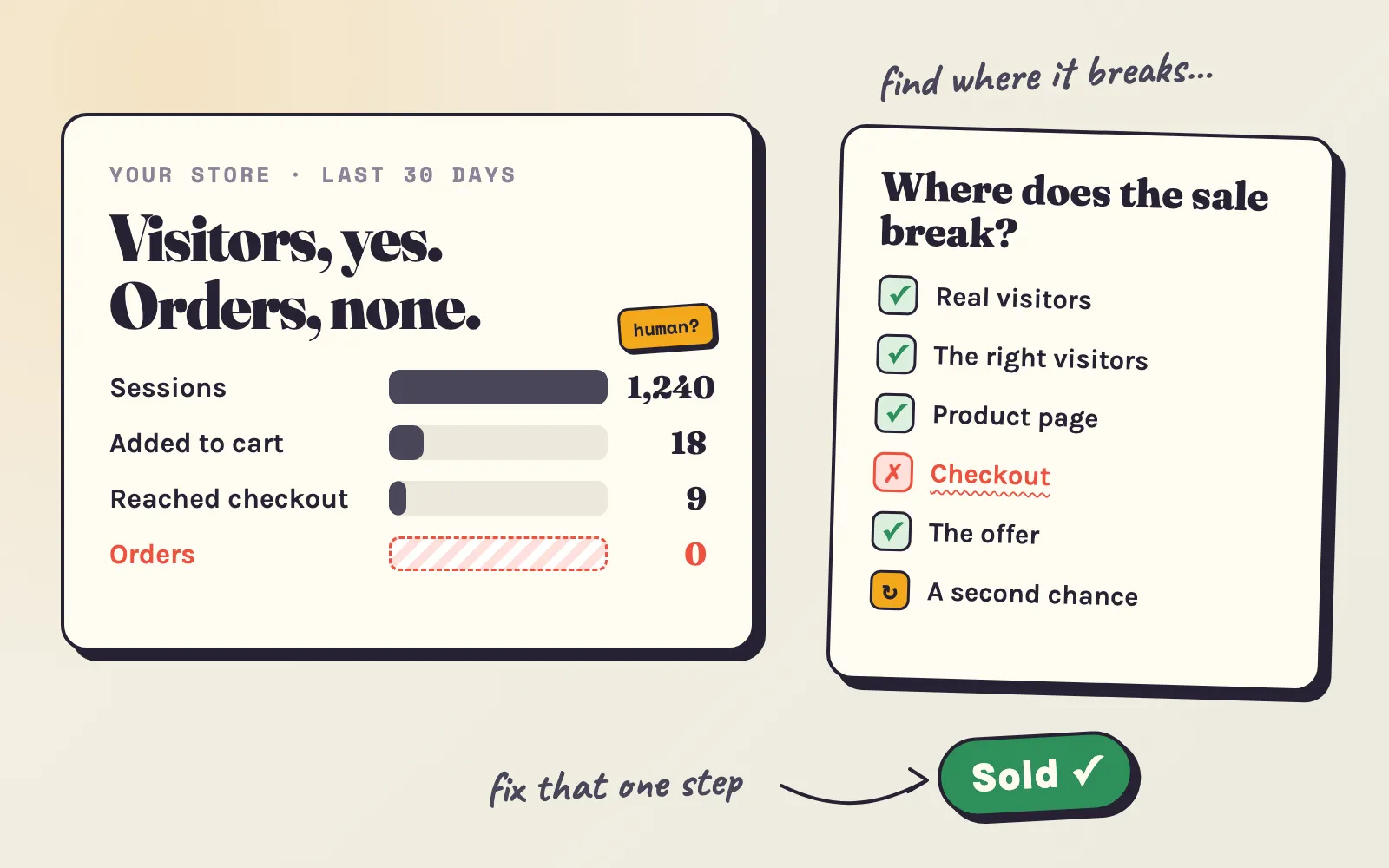
So about 300 visitors is the point where “no sale yet” starts to mean something. Before that, a week without orders says very little about your products or your ads. After 300 real visitors and no order, look at the store first: our guide to no sales on Shopify goes through the usual causes.
How many visitors for regular sales?
One order is luck. Regular orders need steady traffic. Here is what each goal takes at 1%, and what it would cost on three popular channels:
| Your goal | Visitors a month | Facebook and Instagram | Google Shopping | TikTok |
|---|---|---|---|---|
| A first order, 95% sure | 300 | $237 | $198 | $300 |
| One order a week, on average | 430 | $340 | $284 | $430 |
| An order in 9 weeks out of 10 | 1,000 | $790 | $660 | $1,000 |
| One order a day, on average | 3,000 | $2,370 | $1,980 | $3,000 |
| An order on 9 days out of 10 | 7,000 | $5,530 | $4,620 | $7,000 |
Notice the “on average”. With one order a week on average, more than a third of all weeks still bring none; with one a day, four days in ten still do. That is normal chance, not a broken store. Try your own traffic:
- Orders a month
- 10$792
- Days with an order
- 28%of all days
- A week with no order
- 9.9%chance, any given week
Orders come, but with quiet days and now and then a quiet week. Judge on four-week totals, never on single days.
Real stores are a little lumpier than the model - weekends, paydays, a sale. This is how regularly the stores in our data sold, by how many orders they had in a month:
What ads cost in 2026, channel by channel
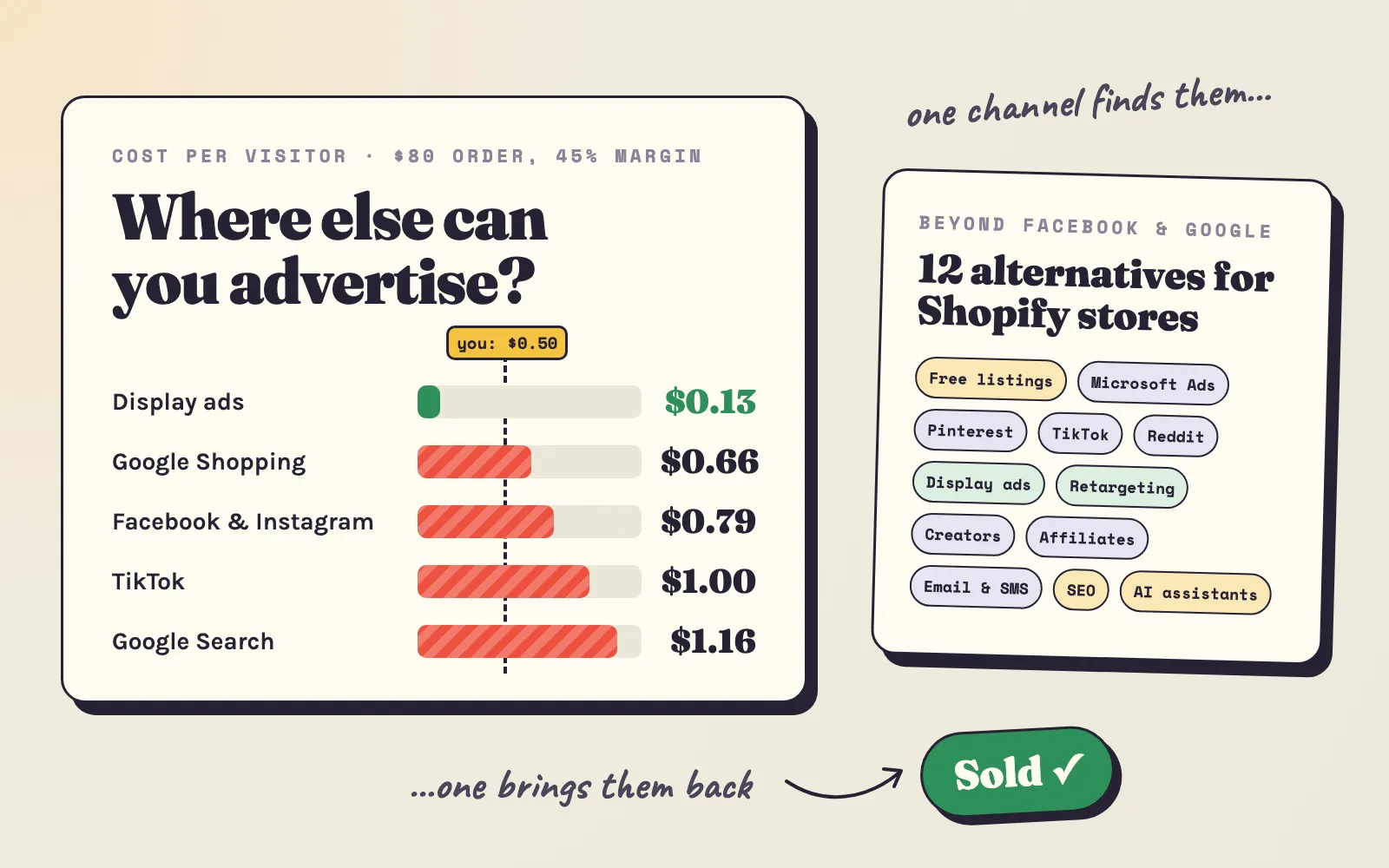
Two prices matter: what 1,000 views cost (CPM) and what one visitor costs (cost per click). CPM tells you how many people see your ad; cost per visitor tells you how many reach your store.
| Channel | 1,000 views (CPM) | One visitor | Visitors per $100 |
|---|---|---|---|
| Adeagle Essential | $1.14-1.39 | $0.05-0.61 | 164-2,000 |
| Adeagle Professional | $0.97-1.25 | $0.15-2.85 | 35-667 |
| Adeagle Ultimate | $0.98-1.92 | $0.15-2.85 | 35-667 |
| $2-8 | $0.20-1.50 | about 118 | |
| TikTok | about $4 | $0.67-2.13 | about 100 |
| $5-6.50 | $0.50-2.50 | about 67 | |
| Snapchat | $6-8 | about $0.84 | about 119 |
| Google Shopping | about $11 | about $0.66 | about 152 |
| Facebook and Instagram | $13.50-15 | $0.70-0.87 | about 127 |
| Google Search | paid per click | $1.16-4.14 | about 86 |
Adeagle, 1,000 views: the pricing page’s estimate over each plan’s budgets - the price moves with the budget you choose. One visitor: what 8 in 10 campaigns paid per real visitor in August-September 2026 (Essential: 70 campaigns of 33 stores; Professional and Ultimate measured together: 21 campaigns of 11 stores). It also depends on your products, your ads and your targeting. Other channels: 2025-2026 ecommerce benchmarks, sources at the end; visitors per $100 use the middle of each range.
Three things to know about these prices:
- Cheap views are not cheap orders. A TikTok view costs a quarter of a Facebook view, but fewer people click (about 0.6% of TikTok views end in a click). A Google Search visitor costs more, but searchers already want the product and buy more often. What counts in the end is the cost per order - which is cost per visitor ÷ conversion rate.
- Established stores pay $25-50 per order. Across ecommerce accounts with $10,000+ of spend, the median cost per purchase was about $49 on Facebook and Instagram and $26 on Google Shopping (Top Growth Marketing), and $39 on Meta across 40,000+ brands (Triple Whale). These are stores with years of data and as the platforms count them. A new store usually pays more at first.
- Prices rise in Q4. By Black Friday week, CPMs were 22-57% higher than in September, depending on the sector - clothing the most, food the least (Supermetrics, 515 retail advertisers). The same budget buys fewer visitors from mid-November to Christmas.
Before you pick a channel, check what your store can pay per visitor - the Facebook and Google Ads alternatives guide has a figure for that, and the CPM calculator and CPC calculator work out your own numbers.
What your budget buys
Type your monthly budget and your conversion rate. The bars show how many visitors the budget buys on each channel; the boxes show what that means for orders.
- Orders a month
- 2.5Facebook and Instagram, at your rate
- At least one order
- 92%chance, in the first month
- On Adeagle
- 134,258-196,224views a month · Professional
First sales. $6.58 a day buys about 253 visitors a month on Facebook and Instagram. Put it on one or two channels, and bring back the visitors who did not buy.
$0 a month: time instead of money
You can get sales without an ad budget. You pay with time instead - and free traffic grows slowly. If an hour of your time is worth $20, forty hours a month of posting and replying is an $800 budget. Spend it on the channels that fit your products:
- Free Google listings. Shopify’s Google & YouTube app puts your products in Google’s Shopping tab and image results for free. It takes about an hour, and it reaches people who already search for what you sell - do it first.
- Short videos and slideshows. TikTok, Instagram Reels and YouTube Shorts can reach people who do not follow you yet. Set your expectations by what brand accounts really get: in 2025, accounts with 1,000-5,000 followers averaged 350 views per TikTok (down from 860 in 2024) and 945 at 5,000-10,000 followers (Socialinsider, 40.7 million videos). On Instagram, accounts of that size averaged 580 views per Reel, 993 per carousel and 417 per image (Socialinsider). Slideshows are faster to make than videos; studies disagree on which reaches more, so test both.
- Pinterest. A pin is found through search for months, while a social post fades in a day or two. It works best for home, fashion, food, crafts and weddings.
- Communities. Reddit, Facebook groups and forums where your buyers ask questions. Help first, mention the store when it answers the question, and always say that it is yours - undisclosed promotion gets accounts banned.
- SEO and a blog. The slowest channel. Only 1.74% of new pages reached Google’s top 10 within a year, and the average page in first place is five years old (Ahrefs, 1 million pages). Start with clear product and collection titles - the words a shopper would type.
- Email. A sign-up form with a small first-order discount, and Shopify’s free abandoned checkout email. Every address is a visitor you can invite back for free.
- Adeagle’s free plan. An ad exchange with other stores: you show partner stores’ ads in your store, and your products appear in theirs. Three stores on it appear in the case studies below - one got its first order from the ads after 12 days.
What to expect. Let’s do the math for TikTok: 30 posts a month at 350 views is about 10,500 views. If 1 in 100 viewers visits your store - and many accounts get fewer - that is about 100 visitors, or about one order. One post that takes off can bring more than a month of average posts, but you cannot plan on it. Most stores that start on free traffic need months, not weeks. Use the time to learn which product and which message people react to - that knowledge makes your first paid budget work much better.
Under $100 a month: a test, not a campaign
What it buys: up to about 125 visitors on Facebook and Instagram, 150 on Google Shopping or 85 on Google Search. On Adeagle’s Essential plan, $50 buys tens of thousands of views and about 80-1,000 visitors - the range 8 in 10 campaigns paid.
What to expect: at 1%, up to about one order a month. The chance of at least one order in the month is about 47% at $50 and 72% at $100. A month without an order is normal here and says very little.
What it can tell you: whether people click (CTR), what a visitor costs you, and whether visitors add to cart - a typical store sees about 6 add-to-carts per 100 visits. Those three numbers are enough to decide what to try next.
Where to spend it: one channel, one product or collection, four weeks. Do not split $100 across four channels - each one gets too few visitors to say anything.
A note on Facebook and Instagram: Meta’s system learns from about 50 purchases a week per ad set. At $39-49 per purchase, that is about $2,000-2,500 a week. A small budget never gets there, and your ad set shows Learning limited. That is expected - judge the test by clicks and cost per visitor, not by the learning status.
$100-$300 a month: the first sales
What it buys: about 125-380 visitors on Facebook and Instagram, 150-450 on Google Shopping. On Adeagle, the Professional plan - the first one with retargeting - starts in this range.
What to expect: one to four orders a month at 1%. At $200 the first order within the first month is about 92% likely; at the top of the range orders come about once a week. The first orders usually come in weeks two to five, because many shoppers come back before they buy (more on that below).
Where to spend it: one channel that brings new visitors, plus a way to bring them back - retargeting and email. Choose the first channel by your product:
- People already search for it (a dog raincoat, a phone case for a known model): Google Shopping, after the free listings.
- People must see it to want it (a new gadget, home decor, fashion): Facebook and Instagram, TikTok or Pinterest.
- You want the most views and visitors per dollar, and to bring visitors back: Adeagle.
Real stores at this stage: a US food store on a $99 budget got its first order from Adeagle ads on day 22, after about 450 ad visitors. A US electrical-supplies store on a $30 budget, with retargeting on, turned $204 over seven months into 10 orders worth $5,830. Both are in the case studies.
$300-$1,000 a month: weekly sales
What it buys: about 380-1,270 visitors on Facebook and Instagram - four to thirteen orders a month at 1%.
What to expect: an order most weeks, but quiet weeks still happen. In our sample, stores with 6-15 orders a month had orders on about a quarter of all days, and a full week without one in four months out of five. Judge on four-week totals.
What changes: you have enough clicks to compare. Run two or three campaigns or ad sets - the same products for different audiences, or different products for the same audience - and keep the best. Judge an ad after a few thousand views, not after a few dozen clicks. Our first weeks guide shows how to set up such a test week by week.
Where to spend it: still mostly one channel for new visitors, now with retargeting set to bring back the visitors from every channel. On Facebook and Instagram, keep it to one campaign with a broad audience, so the purchases you do get are not split into many ad sets that all stay in learning.
$1,000-$3,000 a month: orders most days
What it buys: about 1,270-3,800 visitors on Facebook and Instagram - thirteen to thirty-eight orders a month at 1%.
What to expect: orders on most days. In our sample, stores with 16-30 orders a month sold on 45% of days, and stores with 31-60 on 65%.
What changes: profit decides now. At this budget, a small difference in cost per order is real money. An $80 order that leaves you 45% before ads makes $36 - but the median store on Facebook and Instagram pays about $49 per purchase. So the first order often loses money, and the store earns on the second and third order of the same customer. Two numbers to know:
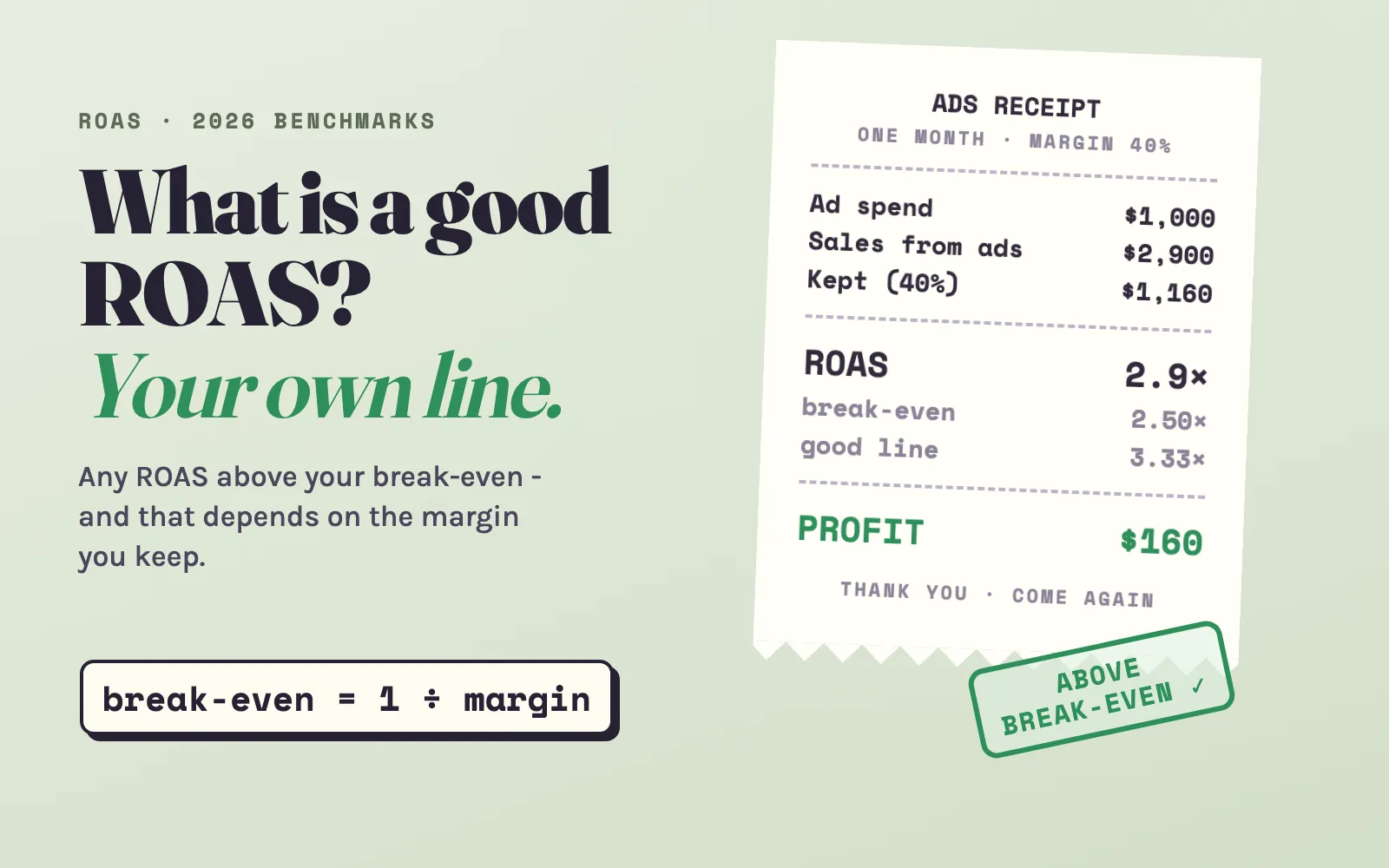
- your break-even ROAS - 1 ÷ your margin before ads. At 45%, that is 2.2×. The ROAS calculator and the guide what is a good ROAS show how to find yours;
- what a customer is worth over time - the customer lifetime value calculator.
Where to spend it: add a second channel for new visitors, and give retargeting a larger share - on Adeagle up to a third of the budget.
$3,000 a month and more: scaling
What it buys: about 3,800 visitors and more on Facebook and Instagram. At $5,000 that is about 6,300 visitors and 63 orders at 1% - orders on about 9 days out of 10 for the stores in our sample.
What changes: the big platforms’ systems now get enough purchases to learn. At $39-49 per purchase, one ad set needs about $8,500-10,500 a month to reach about 50 purchases a week. Below that, fewer campaigns with more budget each work better than many small ones.
How to grow: raise the budget of what works by 20-30% at a time and give each step a week. A jump to three times the budget brings new audiences and placements that need their own learning. Refresh your ads every few weeks, plan for higher costs from mid-November (Black Friday marketing strategy), and judge the whole budget by total sales ÷ total ad spend, not only by each platform’s own report.
Why the first sale takes weeks
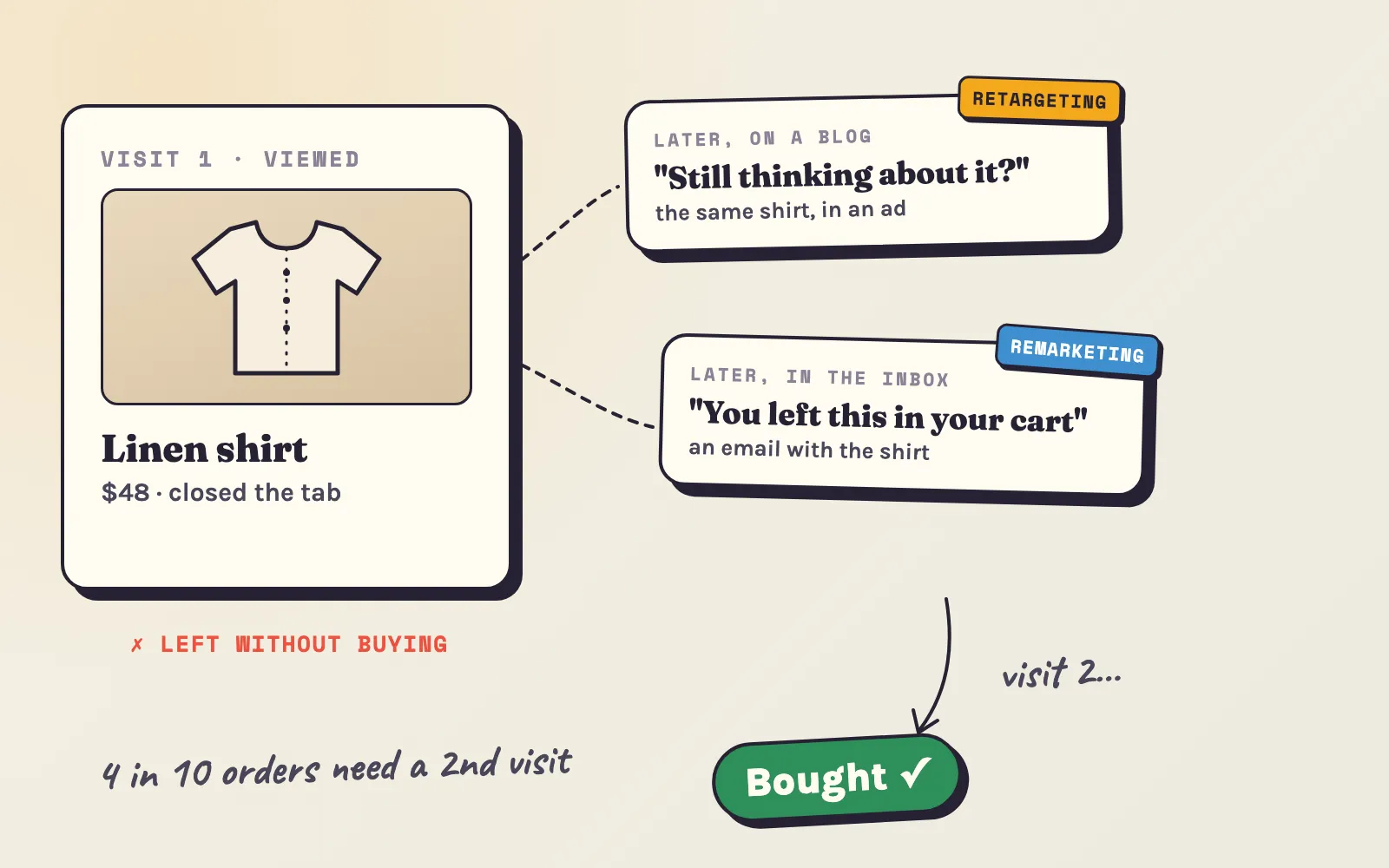
Most shoppers do not buy on their first visit. They look, leave, compare and come back. We counted the visits before each order in a sample of 112 Shopify stores:
43% of orders came after two or more visits, and 23% after three or more. For a new store this has two consequences:
- Your first visitors buy later. The visitors of week one make their second and third visits in weeks two to four. That is why the first orders come after a few weeks, and why a budget stopped after ten days loses the orders it already paid for.
- Bringing visitors back is the cheapest sale. A returning visitor buys almost three times as often as a new one. In multi-visit orders, the last visit was a typed-in address or a search in two out of three cases - the ad did its work earlier. Retargeting and email make those returns happen; retargeting vs remarketing explains both.
What to expect from Adeagle
Adeagle shows your products as display ads on partner stores, websites and mobile apps. These are its numbers, measured on real visitors only:
Why the plans with retargeting cost more per visitor - and sell more. Their visitors cost more on average, and the spread between campaigns is wide. What these plans add is retargeting - so judge them by sales, not by visitors. A first-time view rarely sells by itself - it introduces your products to a new shopper at a low price. The sale usually comes when that shopper sees the products again: a retargeting ad shows visitors who did not buy the products they looked at, on the sites and apps they use next. With the default 20% of the budget on retargeting, our data gives an estimated 3.1× return on ad spend after a click, and about 5× at the maximum share of 33%. The full calculation is in what is a good ROAS.
How to get there:
- Switch on the app embed on day one. It builds your retargeting audience from every visitor - from Adeagle, social, search or email. A visitor before the embed is a visitor you can never bring back.
- Choose a plan with retargeting - Professional or Ultimate - once you have visitors to bring back. Raise the retargeting share after two or three weeks, when the audience has grown.
- Feed it visitors from everywhere. Free traffic and other ads fill the same audience. Adeagle retargeting then brings back the ones who did not buy.
- Give it four to five weeks before you judge it, and follow the first weeks guide while you wait.
Real stores: what they spent and when the first orders came
Six results from stores using Adeagle, anonymised. They show the range: some stores sell in days, some need months, and returning shoppers are behind most of the best results.
An established store with about 60 orders a month, on Essential with retargeting switched on. $204 over seven months brought 10 orders worth $5,830, all after a click on a retargeting ad. The shopper of the first one visited six times - from Google, ChatGPT, the retargeting ad, ChatGPT again, a typed-in address and Google.
After about 450 ad visitors, a $130 order - three times the store's average - after a click on a retargeting ad, on the shopper's third visit. Eight weeks in: 4 orders worth $343 from about $235 of budget, two after a click and two after a view.
A $39 order on the shopper's third visit: a typed-in address, a visit from an unknown source, then the Adeagle ad that brought the sale. A second order from the ads came three months later.
The first order from the ads, $134, came on day 26. The buyer visited the store 22 times before ordering - the Adeagle ad brought visit number 10.
Expensive products take longer. The first orders from the ads came in the fourth month: one shopper who had been in the store before came back through an Adeagle ad and ordered twice - $340 and $429, on two days in a row.
The median time from the first campaign to the first order from the ads, in a sample of 18 stores. 13 of them got it within four weeks.
What they have in common:
- The first order came in weeks two to four for the stores with typical prices - and in month four for the store with $570 orders. The more an order costs, the longer shoppers think.
- Almost every buyer came back at least once. One came back 22 times. Without a way to bring visitors back, many of these orders would have gone elsewhere.
- Retargeting carried the best result. The electrical-supplies store spent little, but every one of its ten orders came from a shopper who had visited before.
How to spend your first $300
A plan for a store with no sales yet and a budget of $100-300 a month:
- Before the adsMake the store readyShipping costs and delivery time next to the price, real photos, a reason to trust you (reviews, an about page, a clear returns policy), fast pages on phones. Switch on email sign-up and the abandoned checkout email.
- Day 1Measure everythingShopify's analytics, the pixel of each ad channel, and the Adeagle app embed - so every visitor counts and can be brought back.
- Weeks 1-2One channel, one heroYour best product or collection on one channel that brings new visitors. Free Google listings and organic posts in parallel.
- Weeks 2-3Read the first numbersClick rate, cost per visitor, add-to-carts. Fix the weakest step: the ad, the product page or the price.
- Weeks 3-4Bring visitors backRetargeting on, with a share of the budget growing as the audience grows.
- Week 5DecideFour weeks of numbers, about 300-400 visitors: keep, change one thing, or move the budget to another channel.
Mistakes that waste a small budget
- Splitting $100 across four channels. Each one gets 25-30 visitors - not enough for a single conclusion.
- Judging after a few days. Before about 300 visitors, a lack of orders is mostly chance.
- Stopping after the first quiet week. The visitors you paid for in week one buy in weeks two to four.
- Expecting Meta’s system to learn on $5 a day. It learns from about 50 purchases a week per ad set; a small budget is a test of clicks.
- Ads before the store is ready. Surprise shipping costs, no reviews or a slow page waste every visitor you pay for - our conversion rate guide finds the leak.
- Forgetting the margin. An order that costs more in ads than it leaves you is a loss, however good the ROAS looks - check it with the CPA calculator.
- No way to bring visitors back. Without email, retargeting or a reason to return, almost half of all possible orders are lost.
Free tools for planning your budget
- Ad budget calculator - the budget an order goal needs, or the orders a budget brings.
- Conversion rate calculator - your rate, and what each half point is worth.
- CPM calculator and CPC calculator - what views and visitors cost you.
- ROAS calculator - your break-even line.
Ready to bring your first visitors back? Add Adeagle from the Shopify App Store, follow the getting started guide, and compare the plans on the pricing page.
Sources: Shopify conversion rates - Littledata (438 stores, August-October 2026); new and returning visitors - Top Growth Marketing (33 DTC stores); Facebook and Instagram CPM and cost per purchase - Top Growth Marketing (15 brands, July 2025 - June 2026) and Triple Whale (40,000+ brands); Google Shopping and Search - Top Growth Marketing (28 brands) and 2025-2026 benchmark roundups; TikTok - Triple Whale via Top Growth Marketing (5,900+ brands); Pinterest - Trackbee and Tailwind; Snapchat - Enrich Labs; Reddit - Stackmatix; Q4 prices - Supermetrics; Meta’s learning phase - Meta Business Help Center; organic reach - Socialinsider TikTok and Instagram benchmarks; time to rank - Ahrefs. Adeagle data: our own ad serving (August-October 2026) and, for orders and visits, Shopify’s record of each order in samples of stores using Adeagle (2026).
Questions
Start with a budget you can keep for four to eight weeks without needing the money back - for most new stores $100-300 a month on one or two channels. On Facebook and Instagram that buys about 130-380 visitors a month, enough for a first order or a few at a 1% conversion rate. Below $100 a month you test whether people click, not whether ads make money.
About 100 on average at a 1% conversion rate, and about 300 to be 95% sure of at least one order. A store that converts 2% needs half of that. A good product page and a fair shipping price change these numbers more than any ad setting.
About 100 a day - 3,000 a month - at a 1% conversion rate. Orders then come on about 6 days out of 10, because orders arrive at random. For an order on 9 days out of 10 you need about 230 visitors a day.
It is enough for a test, not for steady sales. $5 a day buys about 190 visitors a month at about $0.79 each - about two orders at a 1% conversion rate. Meta's system learns from about 50 purchases a week per ad set, so at $5 a day judge the ads by clicks and cost per visitor, not by the learning status.
Shopify has no ad fee of its own - you pay the channel. In 2026, 1,000 ad views cost about $1-2 on Adeagle, about $4 on TikTok, about $11 on Google Shopping and $13.50-15 on Facebook and Instagram. One visitor costs about $0.66 on Google Shopping, $0.79 on Facebook and Instagram and $1.16 or more on Google Search. On Adeagle 8 in 10 campaigns paid $0.05-0.61 per visitor on the Essential plan and $0.15-2.85 on the plans with retargeting.
Yes, but you pay with time instead. Free Google listings, short videos, Pinterest, communities and email all bring visitors, usually slowly - brand TikTok accounts with 1,000-5,000 followers averaged 350 views per post in 2025, and only 1.74% of new pages reach Google's top 10 within a year. Expect months, not weeks.
Usually two to five weeks. Many shoppers buy on their second or third visit, so the first orders come once the first visitors return. In our data, the median store got its first order from Adeagle ads after 19 days, and 13 of 18 stores within four weeks.