
Facebook and Google still bring most small stores their paid traffic, and both keep getting more expensive. Meta’s average price per ad was 12% higher in the second quarter of 2026 than a year earlier (Meta 10-Q). On Google, the cost per click went up in 87% of industries in 2025 (WordStream), and LocaliQ’s 2026 benchmarks put the average click at $5.42 (LocaliQ). For a store that sells $40-80 products, the math often stops working: a visitor costs more than the visitor’s order can pay back.
So where else can you advertise? This guide goes through twelve alternatives - what a visitor costs on each, the minimum to start, the work it takes and the kind of store it suits. It starts with the one number that tells you which channels your store can afford, and ends with a plan to test a new channel without burning money. Adeagle does two of the twelve - display ads and retargeting. We say where it fits, and where it doesn’t.
Do you need a new channel, or a fix?
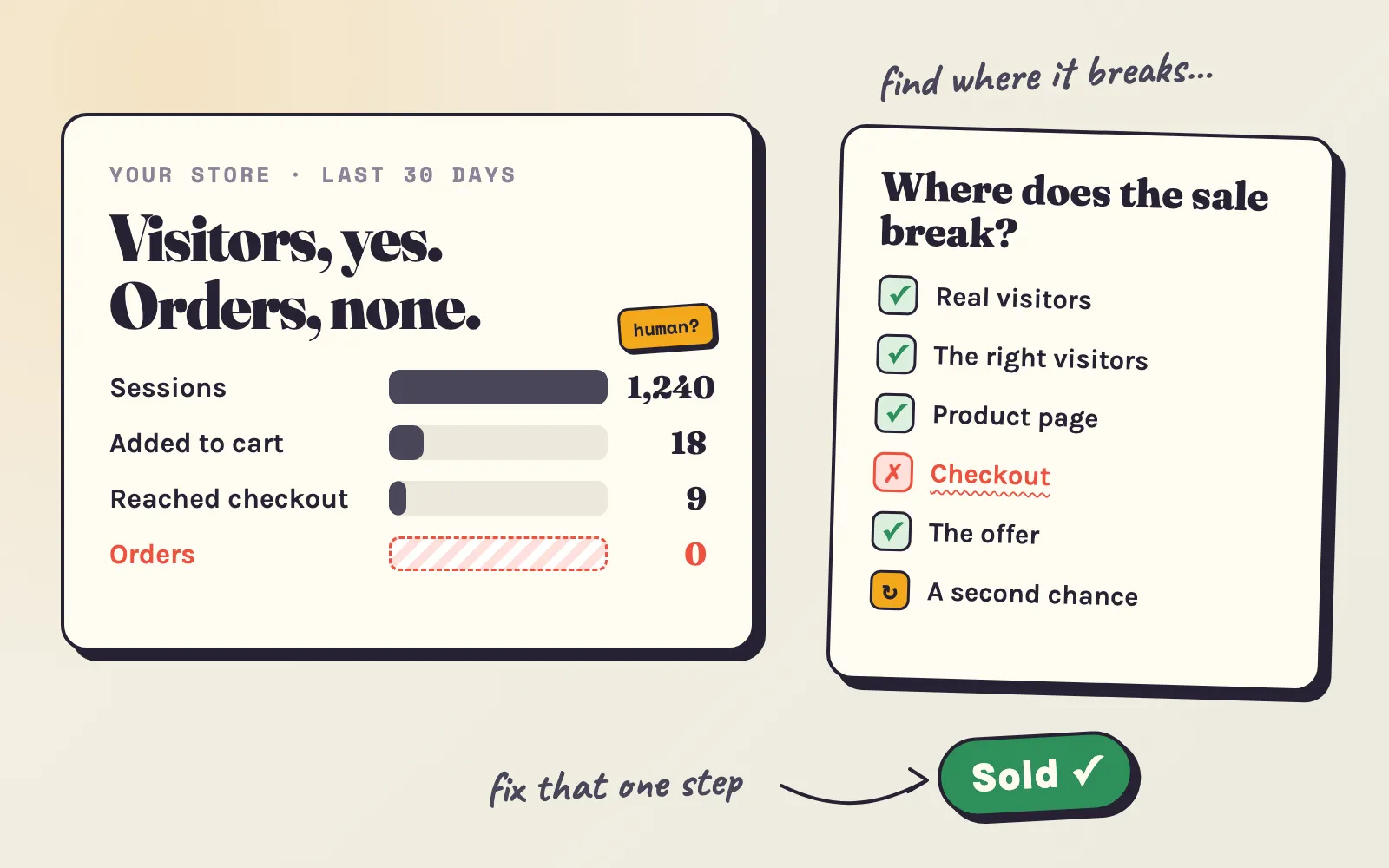
A new channel won’t help if the problem is in the store - the same visitors who don’t buy from a Facebook ad won’t buy from a Pinterest ad either. Before you move any budget, find out which side the problem is on:
Fix the store first if…
- Shopify shows more orders than your ad report. Counting changed several times in 2026 - the sales may be there. How to check.
- Visitors add to cart and then leave. Surprise shipping costs or a slow checkout will sink every channel. Find the step with the leak finder.
- Your conversion rate fell while traffic stayed the same.
- Your offer is weaker than the store next to it in the search results - price, delivery time, reviews.
Look for a new channel if…
- A visitor costs more than your orders can pay - the next section shows how to tell.
- Your buyers aren't there. Replacement parts on TikTok, or a niche hobby too small for broad audiences.
- You can't feed the channel. TikTok wants new videos every week, Google wants a clean product feed.
- One channel holds half your sales, and a price change or a blocked account would hit them all.
What can your store pay for a visitor?
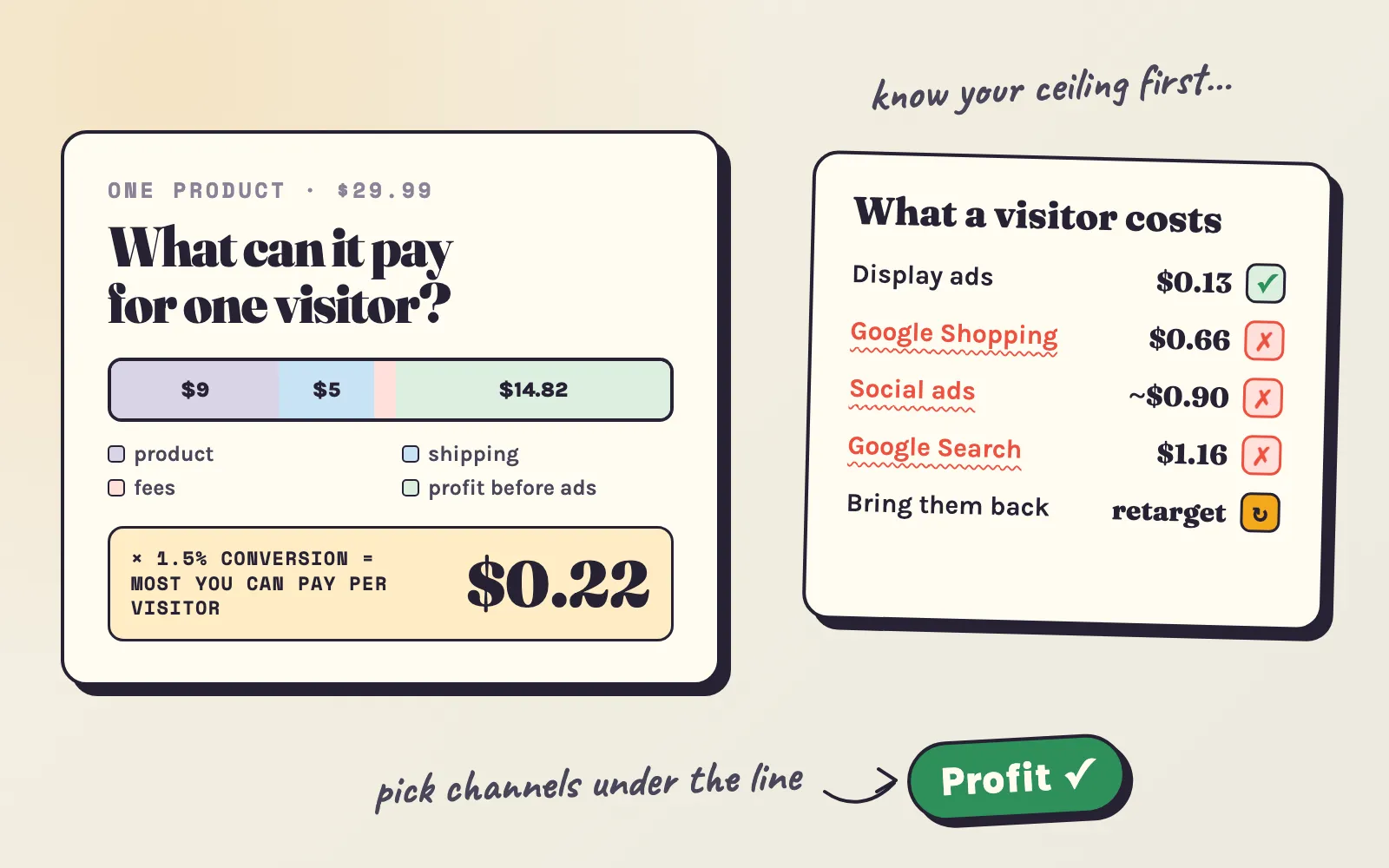
Every ad channel sells you visitors. Whether one works for you depends on a single number - the most you can pay for a visitor before the first order loses money:
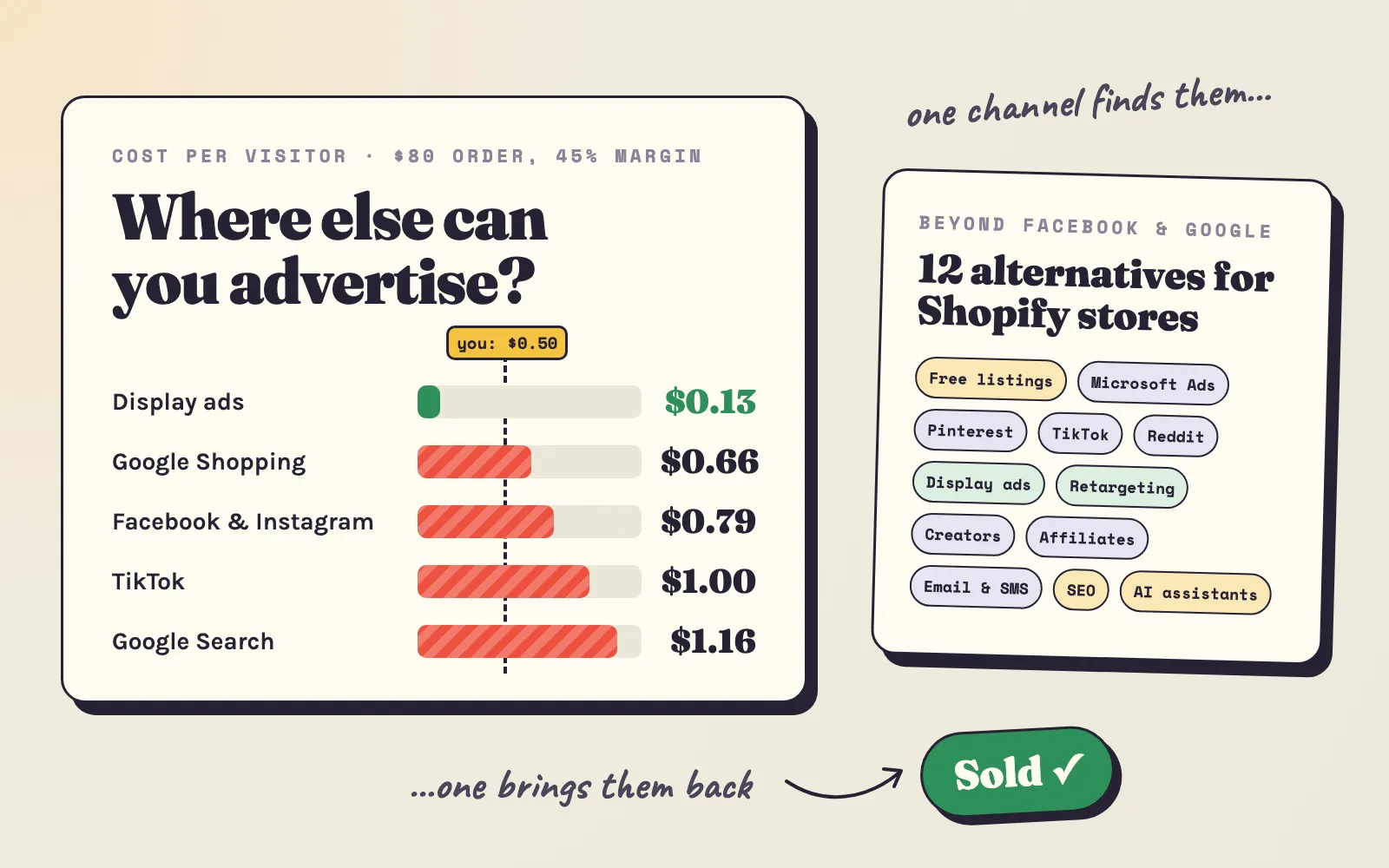
An $80 order that leaves you $36 after the product, shipping and payment fees (a 45% margin), at a 1.4% conversion rate: $36 × 1.4% = about $0.50 per visitor.
$80 is close to the median order in a sample of 297 Shopify stores using Adeagle - apparel, home & garden, health & beauty and electronics among them (by vertical on the CPA calculator page) - and 1.4% is the average Shopify conversion rate. Now put in your own numbers and see which channels fit under that line:
The black line is your conversion rate. Each bar is the share of a channel's visitors who must buy for the first order to pay for them - left of the line fits, up to the end of the bar needs up to twice your rate.
Fits your numbers: Adeagle - a first order pays for its visitors at your 1.4% conversion rate. Google Shopping, Facebook and Instagram, Pinterest and TikTok need up to twice your rate - worth it only if those visitors buy more often than your average. Searchers and returning visitors often do; cold social visitors rarely.
How to read it. Your conversion rate is an average over all your visitors. People who searched for the product usually buy more often than that, people who scrolled past a social ad less often, and people who come back to a product they already viewed much more often. So a channel a little right of the line can still work if its visitors are warmer than your average. A channel far right of it needs an exceptional product or ad.
The cheapest fix is often not the channel at all. A bundle or a free-shipping threshold that lifts the average order from $80 to $100 moves every bar to the left - try it in the figure.
Facebook and Google Ads alternatives at a glance
The giants’ own ads are in the first three rows, for comparison. Costs are per visitor (per click):
| Channel | Cost per visitor | To start | Work | Best for |
|---|---|---|---|---|
| Facebook and Instagram ads | $0.70-0.87 | A few dollars a day | Medium - new ads every few weeks | Finding new buyers by interest |
| Google Search ads | about $1.16, often more | No minimum | Medium - keywords and bids | People searching for what you sell |
| Google Shopping ads | about $0.66 | No minimum | Medium - product feed | Products people search for by name |
| Free Google listings | Free | Google & YouTube app | Low | Every store with physical products |
| Microsoft Ads | Often less than Google for the same words | No minimum spend | Low - copies your Google campaigns | Stores that already run Google Ads |
| TikTok ads | about $0.67-2.13 | $50 a day per campaign | High - new videos every week | Products with a “wow” on camera |
| Pinterest ads | about $0.20-1.50 | No minimum | Medium - vertical images | Home, fashion, beauty, gifts, weddings |
| Reddit ads | about $0.50-2.50 | $5 a day | Medium - must fit the community | Hobbies, gear, tech, niche products |
| Display ads on related stores, sites and apps | $0.13 on Adeagle Essential | A monthly plan | Low - the ads are made from your products | Cheap, relevant visitors |
| Retargeting | Less per visit than ads to new shoppers | Part of the ad tool | Low | Visitors who left without buying |
| Creators and influencers | A free product, up to $200+ per post | A few products | Medium - finding the right people | Trust, and new videos for your ads |
| Affiliates and Shop Campaigns | A commission or a fee per sale | Nothing up front | Low to medium | Paying only when someone buys |
| Email and SMS | Shopify Email: 10,000 emails a month free | Free | Low to medium | Abandoned carts, repeat buyers |
| SEO and content | Free, costs time | Free | High - months, not weeks | Traffic that keeps coming |
| AI assistants | Free | Complete product data | Low to medium | Being suggested in ChatGPT and others |
Costs per visitor: published 2025-2026 benchmarks - sources at the end. They change with country, season and product, and campaigns optimised for sales cost more per click than campaigns for traffic. Adeagle: what stores paid per real visitor on the Essential plan, August-September 2026.
Leaving one giant? Try the other first
The most common move isn’t to a new channel at all - it is to the other big one. They do different jobs, so a store that only uses one of them is usually missing half its buyers.
Leaving Facebook → Google Shopping. Shopping ads show your product photo, name and price when someone searches for it. Clicks cost about $0.66, and they are warm: the shopper has seen the price before clicking. Start with free listings (below), then run Shopping ads only for your three to ten best sellers. The trap is Merchant Center: Google suspends stores whose details don’t add up - no contact page, vague returns, a price or shipping cost in the feed that differs from the store. Fix those before you apply.
Leaving Google → Facebook and Instagram. If your product is new or unusual, few people search for it, and search ads can’t find buyers who don’t know it exists. Meta can: it shows your ad to people likely to want it, before they search. It costs more than it used to and has had a rough 2026, so read why Meta ads stopped converting before you start - and judge it on two to four weeks, not on the first days.
Alternatives to Facebook ads: finding new buyers
Facebook’s strength is discovery - showing a product to people who didn’t know they wanted it. These channels do the same job, each for a different kind of product.
TikTok ads
Best for: products with a visual “wow” - gadgets, beauty, kitchen, pets - and stores that can make new videos every week.
What it costs: views are often cheaper than on Meta, but fewer people click. A panel of 5,900+ brands reports a median of $4.08 per 1,000 views and a 0.61% click rate - about $0.67 per visitor (TopGrowth, Triple Whale data) - while Triple Whale’s own report puts views nearer $13 per 1,000 (Triple Whale). Plan on about $1 per visitor until you have your own numbers. TikTok asks for at least $50 a day per campaign and $20 a day per ad group.
What works: videos that look like a person’s post, not an ad - filmed on a phone, a hook in the first second, the product in use. Creator videos run as ads usually beat a brand’s own.
Watch out: a TikTok video often wears out within one to two weeks. If you can’t make two or three new clips a week, this channel will be expensive for you.
Pinterest ads
Best for: things people plan and save - home decor, fashion, beauty, weddings, gifts, recipes and kitchenware.
What it costs: about $0.20-1.50 per visitor and $2-5 per 1,000 views, with no minimum budget (Tailwind).
What works: people open Pinterest to collect ideas, so an ad that looks like a good pin - the product styled in a room or an outfit, vertical, with a short line of text - fits right in. Pins keep bringing visitors for months, and the free ones do too, so pin your products even if you don’t pay for ads.
Watch out: Pinterest buyers plan ahead. Judge it on 30 days, not the first week.
Reddit ads
Best for: products for a hobby with its own community - cycling, fishing, mechanical keyboards, skincare, board games, home coffee.
What it costs: about $0.50-2.50 per visitor and $3-9 per 1,000 views, from $5 a day (Stackmatix).
What works: ads that read like a post from someone who knows the hobby - the specs, the honest trade-off, a real photo. Reddit lets you target communities by topic, so a small store can reach exactly the people who care.
Watch out: Reddit users dislike anything that feels like hidden selling. Expect comments under your ads, answer them like a person, and never post as a “fan” of your own store - communities ban accounts for it.
Display ads on related stores, websites and apps
Best for: stores whose margin can’t pay social or search prices, niche products, and anyone who wants cheap visitors who are already interested in the product category.
What it is: your product - photo, name, price - shown as an ad in other online stores, on niche websites and blogs, and in mobile apps whose readers match your product categories. A shopper reading a hiking blog sees your backpack; a shopper browsing another store’s dog beds sees your dog bowls.
What it costs: on Adeagle about $0.13 per visitor on the Essential plan and $0.30 across all plans, counting real visitors only (August-September 2026). The ads are made from your products in every common banner size, and you choose the product categories and shopper interests they appear next to.
Watch out: a shopper who sees your product for the first time on a blog is colder than one who searched for it. Judge display ads on orders over two to four weeks, count the sales that come after a view without a click (post-view conversions), and pair them with retargeting - below.
Creators and influencers
Best for: new stores without many reviews, products that need to be shown in use, and stores that need fresh videos for their ads.
What it costs: often just the product for very small creators. Shopify’s own estimate is $5-200 per post for nano creators and $200-1,200 for micro creators (Shopify).
What works: send the product to 20-40 small creators (5,000-50,000 followers) whose audience are your buyers, ask for an honest post, and ask for the right to use their video in your ads. Shopify Collabs helps you find creators and pay them a commission on the sales they bring. Give each one a tagged link from the UTM builder so you can see who sells.
Watch out: follower counts lie. Pick creators by who comments on their posts, not by how many follow them - and make sure paid posts are labelled as ads, as the law requires in the US and EU.
Alternatives to Google Ads: reaching people who search
Google Ads’ strength is intent - the shopper types what they want. These alternatives reach the same people, some of them for free.
Free Google listings
Shopify’s free Google & YouTube app sends your products to Google Merchant Center. Once approved, they can appear in the Shopping tab and other Google results for free (Shopify). It is the same product feed that Shopping ads use, so do this first even if you plan to pay later - you will see which products get clicks before you spend anything. The requirements are the same as for ads: a contact page, a clear return policy, and prices and shipping that match between the feed and the store.
Microsoft Ads
Microsoft’s search ads show on Bing, Yahoo and DuckDuckGo. The audience is much smaller than Google’s, but so is the competition - fewer stores bid on the same words, so a click often costs less. You can import your Google campaigns, Shopping included, in a few minutes, and Microsoft sets no minimum spend. It suits stores whose Google campaigns already work - it is the same intent, often cheaper, with an older and more desktop audience.
SEO and content
Searchers find stores through free results too. In a sample of 112 Shopify stores, Google - ads and free results together - was part of 36% of orders in the median store. Free results come from pages that answer what your buyers search: collection pages named the way people search, product pages with real details, and a few honest guides (“how to choose a hiking backpack”). It takes three to six months, and then it keeps working without a budget.
AI assistants
More shoppers now ask ChatGPT, Copilot, Perplexity or Gemini what to buy. Shopify’s agentic storefronts make the products of eligible stores discoverable in ChatGPT, Copilot and Perplexity, with more assistants to come (Shopify Winter ‘26 Edition) - check your Shopify admin to see whether your store has it. What helps an assistant suggest you is what helps a shopper: complete titles and variants, correct prices and stock, clear policies, and reviews. It is free and still small in most stores, but it is growing fast.
Channels that work next to both
These channels don’t replace Facebook or Google - they make every visitor you already pay for worth more.
Retargeting: bring back the visitors who didn’t buy
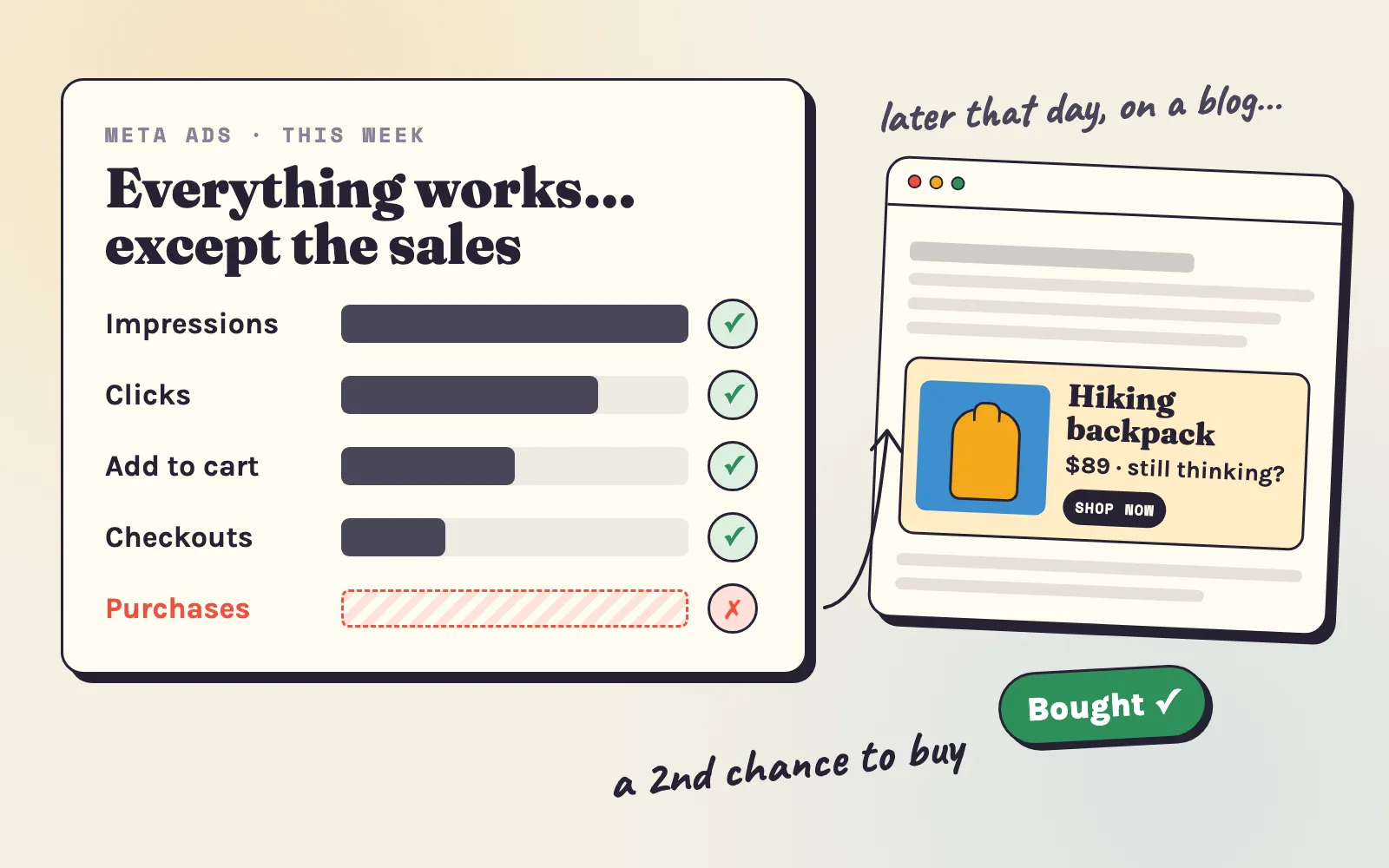
Most visitors don’t buy on their first visit. Retargeting shows a visitor the products they looked at, later, on the other websites and apps they use - and brings them back to finish.
Facebook and Google can retarget too, but only inside their own apps and with their own tracking and prices. Retargeting on other stores, blogs and apps reaches the shopper in the hours they aren’t scrolling a feed, and it is built on your own store’s visitors. What we see across Adeagle stores:
One example: a US store selling electrical supplies, about 60 orders a month, paid $204 for Adeagle over seven months, and its retargeting ads brought 10 orders worth $5,830 - a 28.6× return, post-click. That is our best result so far, not an average. Retargeting is part of Adeagle’s Professional and Ultimate plans; you can add Adeagle from the Shopify App Store and switch it on in a few minutes.
Email and SMS
The cheapest second chance is the one you already own. Shopify sends an abandoned checkout email for free - check that it is on under Marketing > Automations - and Shopify Email includes 10,000 free emails a month (Shopify App Store). On average, abandoned cart emails turn 3.3% of recipients into buyers, and the best senders reach 7.7% (Klaviyo). Add a welcome series for new subscribers and a reminder when a customer’s usual product should be running out. SMS works the same way, but only with the shopper’s clear consent.
The catch: email reaches only people who left an address. Most visitors never do - which is why stores use email and retargeting.
Pay only for sales: affiliates and Shop Campaigns
Two ways to pay only when someone buys:
- Affiliates and creators on commission. Shopify Collabs and affiliate apps give each partner a link and a commission you set. You pay for sales, not clicks.
- Shop Campaigns. Shopify’s own ad program shows your products in the Shop app and other places, and charges you only when a customer converts, at an average acquisition cost you set (Shopify Help Center). Whether your store can use it depends on its country and plan - check in your admin.
Watch out: set the commission or acquisition cost from your break-even, not from what sounds normal - the CPA calculator gives you the most one order may cost. And some of those buyers would have come anyway.
Don’t let one channel hold half your orders
We looked at the visits Shopify records before each order, in a sample of Shopify stores - where each buyer came from, on every visit before the purchase:
Being part of half your orders doesn’t mean a channel made all of them. It means that a price rise, a tracking change or a blocked ad account at one company touches half your sales at once - the October 2026 problems with Instagram ads were a recent example. A second way to reach your shoppers is insurance. And because so many orders take more than one visit, the channel that brings people back is often worth as much as the one that found them.
Which mix fits your store?
By monthly budget:
- $0 a monthFree Google listings, the abandoned checkout email, product pins on Pinterest, one short video a day, and complete product data for AI assistants.
- Up to about $100Add one paid channel that fits under your line in the figure above - display ads on related sites, or Google Shopping for your three best sellers.
- About $300One channel that finds buyers (Shopping or Facebook and Instagram) and one that brings them back (retargeting), plus email flows.
- $1,000 and moreSocial ads for discovery, Shopping and Search for intent, retargeting and email to finish the sale, creators to feed your ads with videos. Test each new channel with 10-20% of the budget.
- The rule at every budgetOne channel to find shoppers, one to bring them back - both chosen from the most you can pay per visitor, not from what is popular.
By the kind of products you sell:
| Your products | Start with | Add next |
|---|---|---|
| Visual, under $50 - gadgets, beauty, decor | Creators, TikTok or Reels, Pinterest | Display ads on related sites, retargeting |
| Searched by name - parts, refills, supplies | Free Google listings, Google Shopping, Microsoft Ads | Retargeting, SEO |
| Considered, over $150 - furniture, bikes, electronics | Google Shopping and Search, buying guides | Retargeting and email - these buyers visit many times |
| Bought again - food, pet supplies, skincare | Email and SMS, affiliates or Shop Campaigns | Display ads to shoppers of similar products |
| Niche hobby - fishing, knitting, model kits | Display ads on niche sites, Reddit, creators | Retargeting |
Expensive products need the second visit most. In our sample, orders of $120 or more came after two or more visits in about half of the cases (median store), against about four in ten for orders under $30.
Adeagle vs Facebook Ads vs Google Ads
Where Adeagle sits next to the two giants:
| Adeagle | Facebook Ads | Google Ads | |
|---|---|---|---|
| Where your ads appear | Other Shopify stores, niche websites and blogs, mobile apps | Facebook, Instagram, Messenger and partner apps | Google Search, Shopping, YouTube, Gmail and partner sites |
| Who sees them | Shoppers interested in your product categories, and your own past visitors | People Meta picks by interests and behaviour | People searching for what you sell |
| What you need | Your products - the ads are made from them | Images or videos, and the Meta pixel | A product feed, keywords and bids |
| Cost per visitor | about $0.13 (Essential) to $0.30 (all plans) | about $0.70-0.87 | about $0.66 (Shopping), $1.16+ (Search) |
| Budget | A monthly plan - the price is your ad budget | A daily or total budget | A daily budget |
| Setup | A few minutes | An hour or more, then a learning phase | Hours, plus the Merchant Center review |
| Retargeting | On the Professional and Ultimate plans | Yes, inside Meta’s apps | Yes, inside Google’s network |
| Best at | Cheap, relevant visitors, and bringing visitors back | Finding new buyers | Catching people who search |
Where Adeagle fits. Adeagle is not a search channel - if people type your product’s name into Google, Shopping ads catch them better. And it is not a replacement for video-led discovery on social media. What it does well is bring you visitors at a price small stores can pay, from places where your buyers already spend time, and bring back the visitors who left. It runs on your own products and your own store’s visitors, so a change at Meta or Google doesn’t change it. Most stores run it next to one of the giants; see the plans, or install Adeagle and set up a first campaign in a few minutes.
How to test a new channel without wasting money
Most channel tests fail because they are judged too early, on the wrong numbers, or run together with three other changes. A test you can trust:
- Pick one channel - the one under your line in the figure above that fits your products. One at a time, so you know what worked.
- Set a budget you can afford to lose: 10-20% of what you spend on ads now, and enough for at least 1,000 visitors. Fewer visitors can’t tell you much. The ad budget calculator shows what that means on each channel.
- Tag every link with the UTM builder, so Shopify shows which orders the channel brought.
- Write down your line before you start: your break-even cost per order (CPA calculator) and break-even ROAS (ROAS calculator). Decided in advance, it can’t be bent afterwards.
- Run two to four full weeks without daily changes. The first days of any channel are its worst.
- Judge on Shopify, not the ad report. Compare total sales ÷ total ad spend for the test weeks with the weeks before, and check orders by source. For display ads, count the sales after a view too.
- Keep, fix or stop. Above your line: keep it and raise the budget step by step. Close: change the ad or the landing page and run two more weeks. Far below: stop and try the next channel.
Free tools to plan it
- Ad budget calculator - the budget your order goal needs on each channel, and whether it pays.
- CPC calculator - choose “Find the most I can pay” for one channel at your margin.
- CPA calculator - what one order may cost you in ads.
- ROAS calculator - the return your ads must reach to make money.
- Conversion rate calculator - your rate next to other Shopify stores, and where buyers drop off.
- UTM builder for Shopify - tagged links for every channel, creator and email.
- Customer lifetime value calculator - how much more you can pay for a customer who comes back.
- Selling with dropshipping? Dropshipping ads goes through the channels for low-price products.
Sources
- Ad prices: Meta Q2 2026 10-Q; WordStream, 2025 Google Ads benchmarks; LocaliQ search advertising benchmarks, 2026
- Cost per visitor: Google Shopping and Search - 2025 ecommerce benchmark roundups (global Shopping average about $0.66; European median EUR 0.34, Smarter Ecommerce Market Observer); Facebook and Instagram - 2025 ecommerce benchmarks (MHI Growth Engine, 1,247 ad accounts; Ryze AI); TopGrowth on TikTok benchmarks and Triple Whale; Tailwind on Pinterest; Stackmatix on Reddit
- Channels: Shopify on free Google listings; Shopify on influencer pricing; Shop Campaigns, Shopify Help Center; Shopify Email; Klaviyo abandoned cart benchmarks; Shopify Winter ‘26 Edition
- Conversion rate: Littledata Shopify benchmark, via Nudgify
- Adeagle data: Shopify customer journeys and ad results from stores using Adeagle, as described under each figure
Questions
There is no single one - it depends on the product. Google Shopping suits products people search for by name, Pinterest suits things people plan (home, fashion, gifts), TikTok and creators suit products that look good on video, and display ads on related stores, websites and apps bring the cheapest relevant visitors. Most stores also need retargeting or email to bring back the visitors who leave. Adeagle does display ads and retargeting inside Shopify.
For the same searches, Microsoft Ads - it shows your ads on Bing, Yahoo and DuckDuckGo, to a smaller audience, often for less per click. Free Google listings and SEO reach searchers without paying per click. If search clicks cost more than your orders can pay, display ads on related websites bring cheaper visitors who are interested in your product category.
Free first - free Google listings, abandoned checkout emails, product pins on Pinterest, short videos and SEO. Among paid channels, display ads on related websites cost the least per visitor - about $0.13 on Adeagle's Essential plan, against about $0.66 on Google Shopping and $0.70-0.87 on Facebook and Instagram. Cheap only matters if the visitors buy, so compare each price with the most you can pay per visitor.
For products people search for by name, often yes - Google Shopping especially, because shoppers see the photo and price before they click. But clicks keep getting more expensive - LocaliQ's 2026 benchmarks put the average click at $5.42 across all industries, and about $1.16 for ecommerce searches. Start with free listings, then Shopping ads on your best sellers, and stop anything that costs more per visitor than your orders can pay.
Usually not. In a sample of 28 Shopify stores, Facebook or Instagram was the first visit in 9 of 10 orders it was part of - it starts many sales that other channels finish. Lower the budget to what your margin can pay, keep your best ads, and add a channel that brings visitors back. Why Meta ads stopped converting in 2026 explains what to check first.
Enough to test one channel properly, not four. At about $0.80 per click, $20 a day buys roughly 25 visitors. At a 1.4% conversion rate that is about one order every three days, so give a test two to four weeks before you judge it - or put the money on a cheaper channel where it buys more visitors.
Yes, but free channels are slow. List your products free on Google with Shopify's Google & YouTube app, send abandoned checkout emails (Shopify Email includes 10,000 free emails a month), pin your products on Pinterest, post short videos, write pages that answer what your buyers search, and keep your product data complete so AI assistants can suggest your products. Adeagle's free plan is an ad exchange - your store shows partner ads, and your products appear in partner stores in return.
No - it is a different channel. Adeagle shows your products as ads in other Shopify stores, on niche websites and blogs, and in mobile apps, and on the Professional and Ultimate plans it brings back the visitors who left without buying. It does not run search ads and does not depend on Meta's or Google's tracking. Most stores run it next to one of them - often to reach shoppers at a lower price per visitor, and to finish the sales the other channel started.
Two to four full weeks, and at least enough budget for about 1,000 visitors. Decide your break-even cost per order before you start, tag every link so Shopify shows which source sold, and judge on the orders in Shopify rather than on the ad platform's own report.