
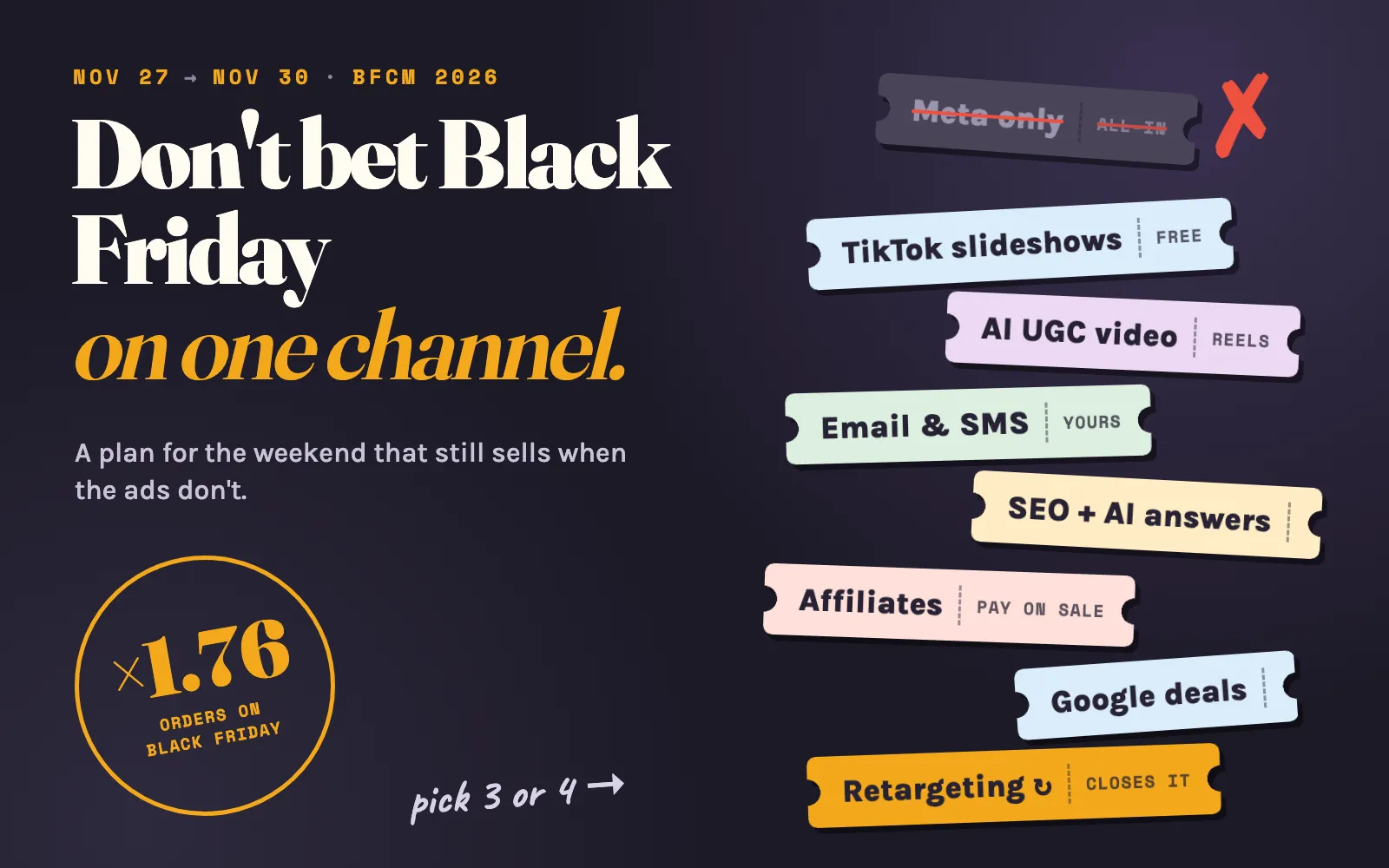
Black Friday falls on November 27, 2026, and Cyber Monday on November 30. For most Shopify stores it is still the biggest weekend of the year: last year Shopify merchants sold a record $14.6 billion over it, 27% more than the year before (Shopify).
But this year many stores go in with a problem. Meta ads - the channel a lot of stores rely on - have been unreliable all autumn, and they are about to get as expensive as they ever get. This guide is a plan for a Black Friday that doesn’t depend on one channel: what each channel is good for, what it costs, and the exact steps to set it up. Every channel section ends with a prompt you can hand to an AI assistant - Shopify Sidekick, ChatGPT, Claude, Gemini or Grok - to do the first draft for you.
Why not bet Black Friday on Meta this year
Meta hasn’t stopped working, but 2026 has made it a riskier place to put all your money:
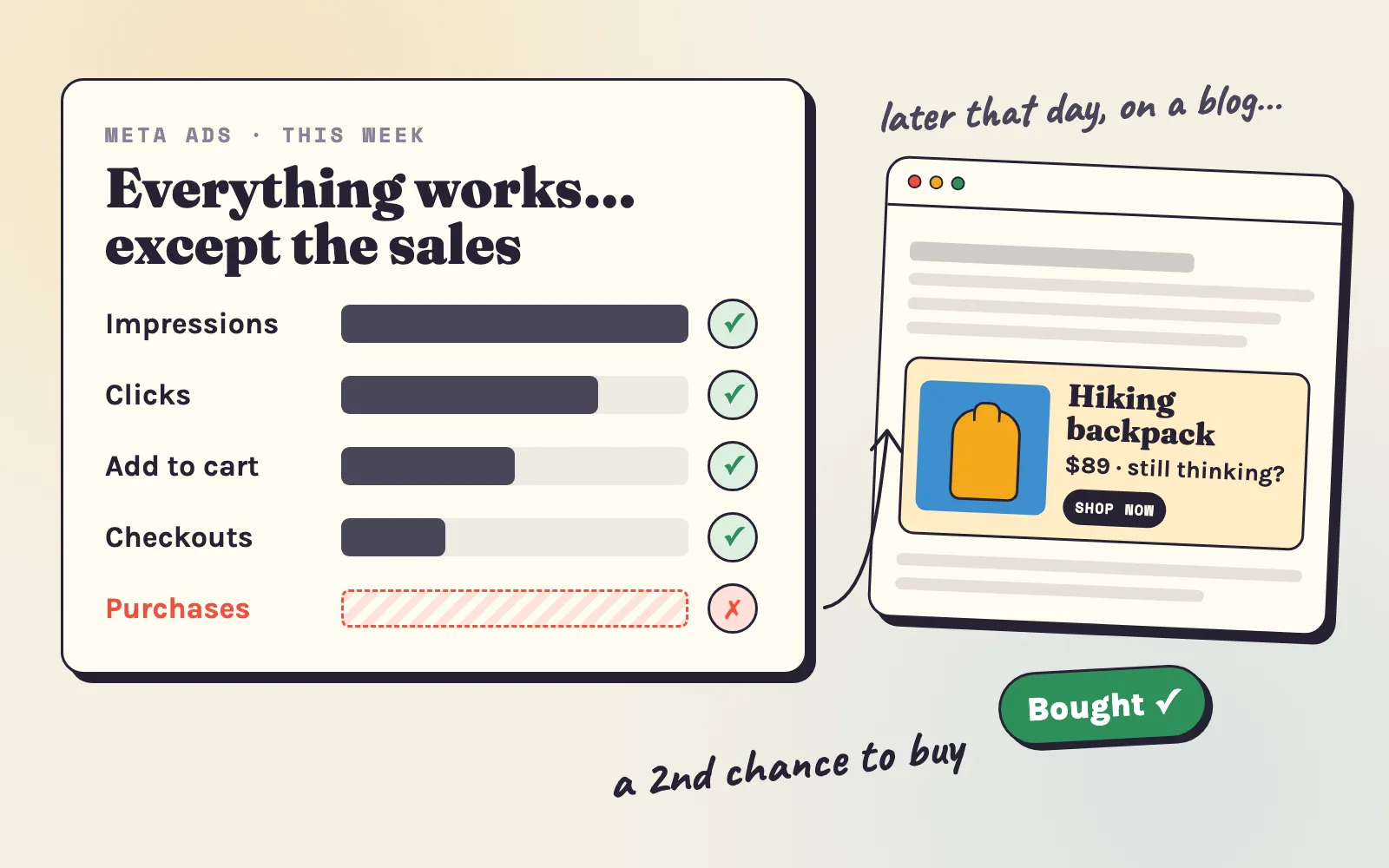
- It counts sales differently. In January and March 2026, Meta changed which sales it counts and when. Many stores now see fewer purchases in Ads Manager than in Shopify.
- It costs more. Meta’s average price per ad was 12% higher than a year earlier in the second quarter (Meta’s report).
- It had a bad October. Meta support told advertisers about a delivery bug on Instagram on October 8-10, and merchants have reported carts without orders all month.
- And late November is the most expensive time of the year. Every brand bids at once: agencies report Q4 prices 30-60% above the rest of the year, peaking from mid-November to Cyber Monday (Leadenforce).
Don’t switch Meta off. Keep your best ads running with a capped budget - and build the rest of your Black Friday on channels you control, channels that charge only for results, and channels where your competitors aren’t bidding.
What Black Friday really did for small stores last year:
Three things in that chart matter for your plan:
- The weekend is the peak, not just the Friday. Saturday sold almost as much as Black Friday itself. Keep your ads, emails and retargeting running through Monday.
- Sales dip in the two weeks before. Shoppers wait for the deals. Don’t panic and don’t start discounting early - use those weeks to build your audience.
- The spread is huge. From Thanksgiving to Cyber Monday, the middle half of stores sold between 0.9 and 2.9 times their normal daily orders. One store in four sold no more than on a normal day.
First, check that your discount pays
The most expensive Black Friday mistake isn’t a bad ad. It is a discount that needs more extra orders than you will get. Try your own numbers:
- Margin left
- 28.6%of the sale price
- Break-even ROAS
- 2.0× → 3.5×before → during the sale
- A typical store got
- ×1.76on Black Friday 2025
That needs more orders than a typical store gets. Black Friday brought a typical store ×1.76 its normal orders; you need ×2.50. Try a smaller discount, a bundle or a gift with purchase.
Ways to give a strong offer without a deep cut:
- A bundle - “buy 2, get the third free” raises the order value instead of cutting the margin on every item.
- A gift with purchase above a threshold - a product that costs you $4 and looks worth $20.
- Free shipping above a threshold set a little over your average order.
- Early access for email subscribers - the same discount, but it grows your list for every sale after.
- A tiered discount - 10% over $50, 20% over $100 - so the deeper discount comes with a bigger order.
The channels, one by one
Each section says what the channel is good for, what it costs, how to set it up, and gives you a prompt to copy. The order follows the calendar: the first ones need weeks, the last ones work in days.
1. Email and SMS: the channel you own
Good for: turning people who already know you into buyers. It is the cheapest sale of the weekend, and no algorithm can take it from you.
Cost: Shopify Email is free up to 10,000 emails a month (Shopify help); SMS costs per message.
How to do it:
- Grow the list now. A pop-up offering early access to your Black Friday deal converts better than a generic newsletter sign-up - and everyone who joins in November is someone you can email on the day.
- Check that your emails arrive. Gmail and Yahoo require bulk senders to authenticate their domain (SPF, DKIM, DMARC), to offer one-click unsubscribe, and to keep spam complaints under 0.3% (Google’s sender rules). Shopify Email sets most of this up when you connect your own domain.
- Plan a short sequence: a teaser a week before, early access for subscribers on Wednesday or Thursday, the launch on Friday morning, a “still on” reminder on Saturday, Cyber Monday, a “last hours” email on Monday evening - and in December, your last order dates for Christmas delivery.
- Switch on the abandoned checkout email (Marketing > Automations). On Black Friday it is the email that makes the most money per send.
I run a Shopify store selling [your products]. My Black Friday offer is [offer], valid [dates]. Write a 7-email Black Friday sequence: a teaser one week before, early access for subscribers on Wednesday, launch on Friday morning, a Saturday reminder, Cyber Monday, a "last hours" email on Monday evening, and a December email with the last order date for Christmas delivery. For each email give 3 subject lines under 45 characters, a preview text, and a short body that leads with the offer. Friendly, not pushy, no fake urgency.
2. TikTok slideshows: reach for the price of a phone
Good for: cheap reach and quick tests. A slideshow - a TikTok post made of photos that people swipe through - takes ten minutes to make, and every swipe tells TikTok people are interested.
What the data says: in a 2025 study of nearly 700,000 posts, photo carousels on TikTok got over 80% more engagement than videos (Fanpage Karma), while larger 2026 studies found videos still win on views (Buffer, Metricool). The practical answer: post both, and use slideshows for the formats that suit them.
How to do it:
- The first slide is the hook. Big text, one promise: “5 gifts under $50 that don’t look cheap”, “What I’d buy on Black Friday as a dog owner”, “Things I regret not buying last Black Friday”.
- Put your product in slide 3 to 5, not slide 1. A slideshow that opens with an ad gets swiped away; one that opens with a useful list keeps people swiping until they reach you.
- Five to eight slides, one idea each, the same font and style, and a trending sound behind it.
- The last slide says what to do: the offer, the date, “link in bio” or a product tag through the TikTok app for Shopify.
- Post one or two a day from mid-November. Repost the slideshows that do well as videos and as Instagram carousels.
I sell [your products] to [your buyers] on Shopify. Write 10 TikTok slideshow scripts for Black Friday. Each one: a hook for slide 1 in under 8 words (a gift list, a comparison, a "what I'd buy", or a "mistakes to avoid"), 5-7 slides with one short line of text each, my product [product name, price] placed in slide 3, 4 or 5 as one of the picks - not as an ad - and a last slide with my offer: [offer, dates]. Suggest a photo for every slide that I can take with a phone.
3. AI UGC video for TikTok, Reels and Shorts
Good for: the video ads and posts that usually need a creator. UGC - user-generated content, a person talking to the camera about a product - is the format that sells best on TikTok and Reels, and AI video models now make it in minutes.
The tools merchants use now:
- Higgsfield - an AI video suite with a marketing studio for product ads: talking-head UGC, unboxing, product reviews and virtual try-on (Higgsfield); reviews put its plans from about €19 a month.
- Seedance 2.5 - a video model released in July 2026, available inside tools like Higgsfield and Arcads; in Higgsfield one clip can run up to 30 seconds.
- Arcads - AI actors for UGC-style ads, with several video models under one subscription.
- Vidhawk - a Shopify app that turns your products into short video ads. Disclosure: it is made by the team behind Adeagle.
How to do it:
- Script first, tool second. The formula that works: a hook in the first 2 seconds, the problem, the product solving it on screen, the Black Friday offer with its end date, and one clear call to action.
- Show the real product. Feed the tool your own product photos; AI can make the person and the setting, but the product must look like what arrives.
- Make five versions with different hooks and keep the two that hold viewers longest.
- Label AI content where the platform asks for it - TikTok and Meta both have AI labels.
Write 5 UGC-style video scripts, 20-25 seconds each, for my product [product name] that [what it does] for [buyers]. Each script: a spoken hook in the first 2 seconds (5 different hook types: a question, a bold claim, a mistake, a before/after, a gift idea), the problem, a product demo described shot by shot, my Black Friday offer [offer] ending [date], and one call to action. Write it as a person talking to a phone camera, in plain everyday words.
4. Steal the structure of hooks that already work
Whatever channel you use, the first second decides. Instead of guessing, look at ads that have been running for weeks - an advertiser rarely keeps paying for an ad that doesn’t sell.
- Free: Meta Ad Library (every active Facebook and Instagram ad, filterable by country) and TikTok Creative Center’s Top Ads.
- Paid, with search and saved swipe files: GetHookd (from about $29 a month), Foreplay (from about $59) and Atria (about $159), which add AI search, filters by how long an ad has run, and boards to save examples (comparison).
How to use them: search your product type and “black friday”, open ads that have run for 30 days or more, and write down the first line and the first image of 20 of them. You will see the same five or six patterns again and again - copy the pattern, never the ad.
Here are 20 hooks from ads that have run for 30+ days in my niche: [paste them]. Group them into hook patterns (for example: price shock, mistake, comparison, social proof, gift idea). For each pattern write 3 new hooks for my product [product name, price, main benefit] and my Black Friday offer [offer]. Keep every hook under 10 words.
5. SEO and AI answers: be the page people find in December
Good for: free traffic from people who search - on Google and, more and more, in ChatGPT, Perplexity, Gemini and Claude, which quote pages that answer the question clearly.
Be realistic: a new page rarely ranks in time for this Black Friday. But gift searches run all of December, and a page you publish now can bring buyers until Christmas - and every Black Friday after it.
How to find a phrase you can rank for:
- Start from your buyer’s question, not your product name: “gifts for new dog owners”, “best [product] for small apartments”, “[product] vs [alternative]”.
- Check the volume and difficulty in a free tool such as Ahrefs’ free Keyword Generator, which shows a difficulty score for each phrase.
- Look at Google’s top 10 for the phrase. Forums, Reddit threads and thin pages on page 1 mean you can win; big brands and magazines mean pick a narrower phrase.
- Write the best answer on the web: the answer in the first lines, a comparison table, real photos, prices, an FAQ. That is also the format AI assistants quote.
- Keep one Black Friday page at the same address every year - for example
/pages/black-friday. Update the offer each year instead of making a new page; the address builds authority year after year.
Example for a pet store: “gifts for dog owners under $50” with ten picks (yours among them, honestly marked), a table by dog size, and an FAQ - a page that can rank for gift searches and be quoted when someone asks an AI assistant for dog gift ideas.
I sell [products] to [buyers]. Suggest 15 long-tail search phrases for gift and comparison searches my buyers type in November and December (for example "gifts for [persona] under $[price]", "best [product] for [situation]"). For the 3 most specific ones, outline a page: the 2-sentence answer at the top, 8-10 product picks (mine included and marked as ours), a comparison table, and 5 FAQ questions with short answers.
6. Google’s free deal listings
Good for: shoppers who search “black friday [product]”. It costs nothing.
How to do it:
- Connect your store to Google Merchant Center with Shopify’s Google & YouTube app, so your products appear free in the Shopping tab, Search and Images.
- Set a sale price on the Black Friday products in Shopify - Google reads it from your product feed.
- Add a promotion in Merchant Center (the Promotions tab) about a week before Black Friday. Products with a sale price or a promotion can get a deal badge and show in Google’s deals results for searches like “black friday” (Search Engine Land).
7. Shop Campaigns: pay only for new customers
Good for: paid reach without paying for clicks that don’t buy. Shopify’s Shop Campaigns show your products in the Shop app and beyond, and you pay only when a new customer places an order, at a cost per customer you set (Shopify). It is open to all Shopify plans in supported countries.
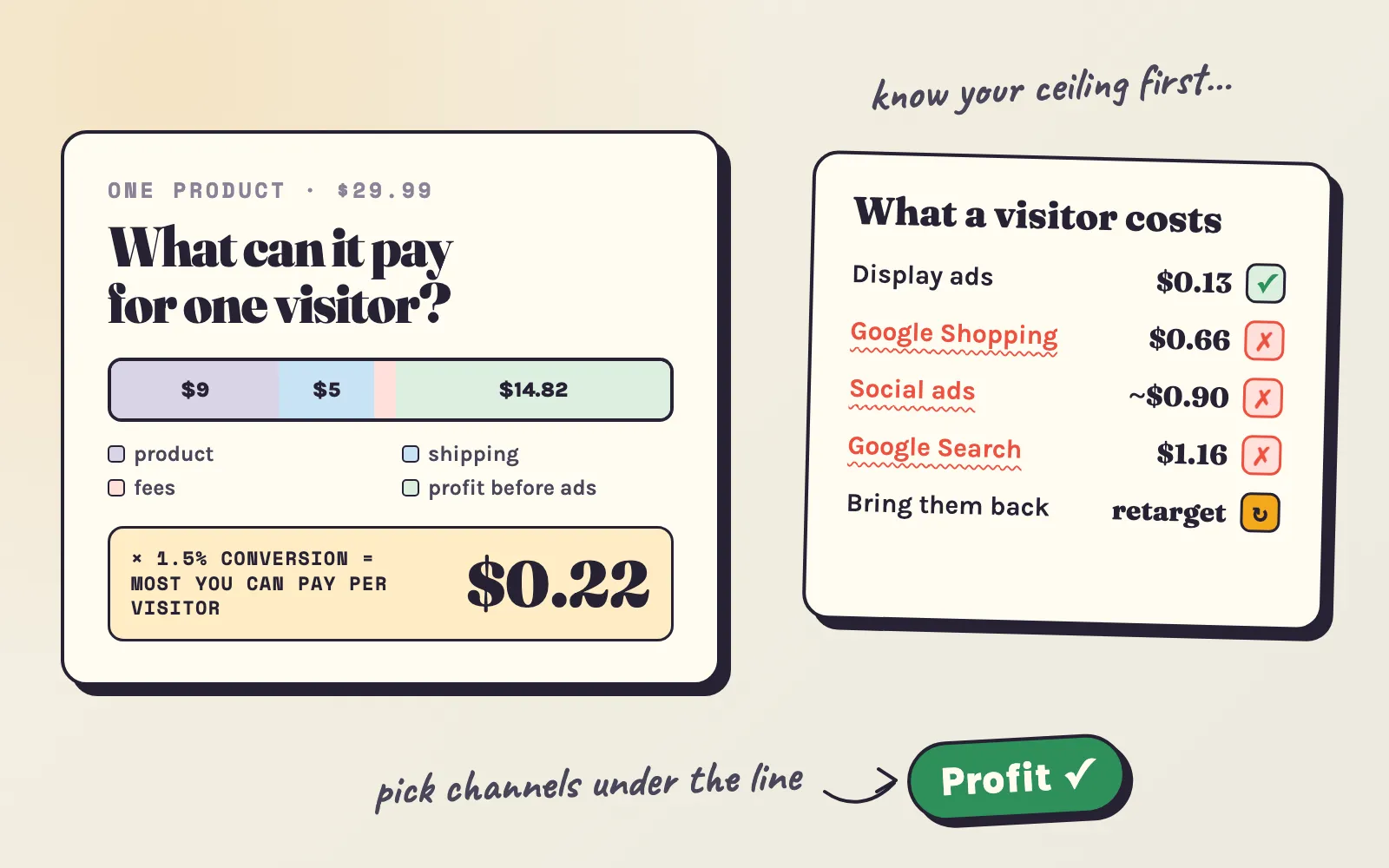
How to do it: open Shop Campaigns from the Shop channel in your Shopify admin, choose your Black Friday products, set the most you will pay for a new customer (use the profit per order from the calculator above) and a daily budget.
8. Affiliates and creators: other people’s audiences
Good for: reaching audiences you don’t have, and paying only for sales. Black Friday is the best week to ask - creators want a strong deal to post.
How to do it:
- Install Shopify Collabs, Shopify’s own affiliate app: set a commission, invite creators or open an application page, and Shopify tracks their sales and pays them (Shopify Collabs).
- Give affiliates something exclusive - their own discount code, or a gift with purchase only through their link.
- Raise the commission for the Black Friday week (for example from 10% to 15-20%), and tell them the dates and the offer by mid-November so they can plan their posts.
- Invite 20-40 small creators whose followers are your buyers, rather than one big name.
Write a short, personal outreach message to a creator with [5,000-20,000] followers about [their niche], inviting them to my affiliate program for my store [store name], which sells [products]. Offer [commission]% on sales during Black Friday week (Nov 23-30), a personal discount code for their followers ([offer]), and a free product to try. Mention one of their recent posts with [placeholder]. Under 120 words, no hype.
9. ChatGPT ads: a small test, not a bet
Good for: reaching people while they ask an AI assistant what to buy - which many will do for gifts this year.
What we know: ChatGPT has shown ads since early 2026, thousands of brands already advertise there (Similarweb), and an OtterlyAI study found a sponsored placement in about three in four shopping-related questions. Results are mixed so far: some stores report a good return, others expensive clicks and few orders, and there is no benchmark yet for what “good” looks like (Search Engine Journal).
How to do it: if you sell giftable products, set a small, capped budget for the two holiday weeks only, and judge it by new customers and searches for your store name afterwards - not by same-day sales.
10. Retargeting: be there while they compare
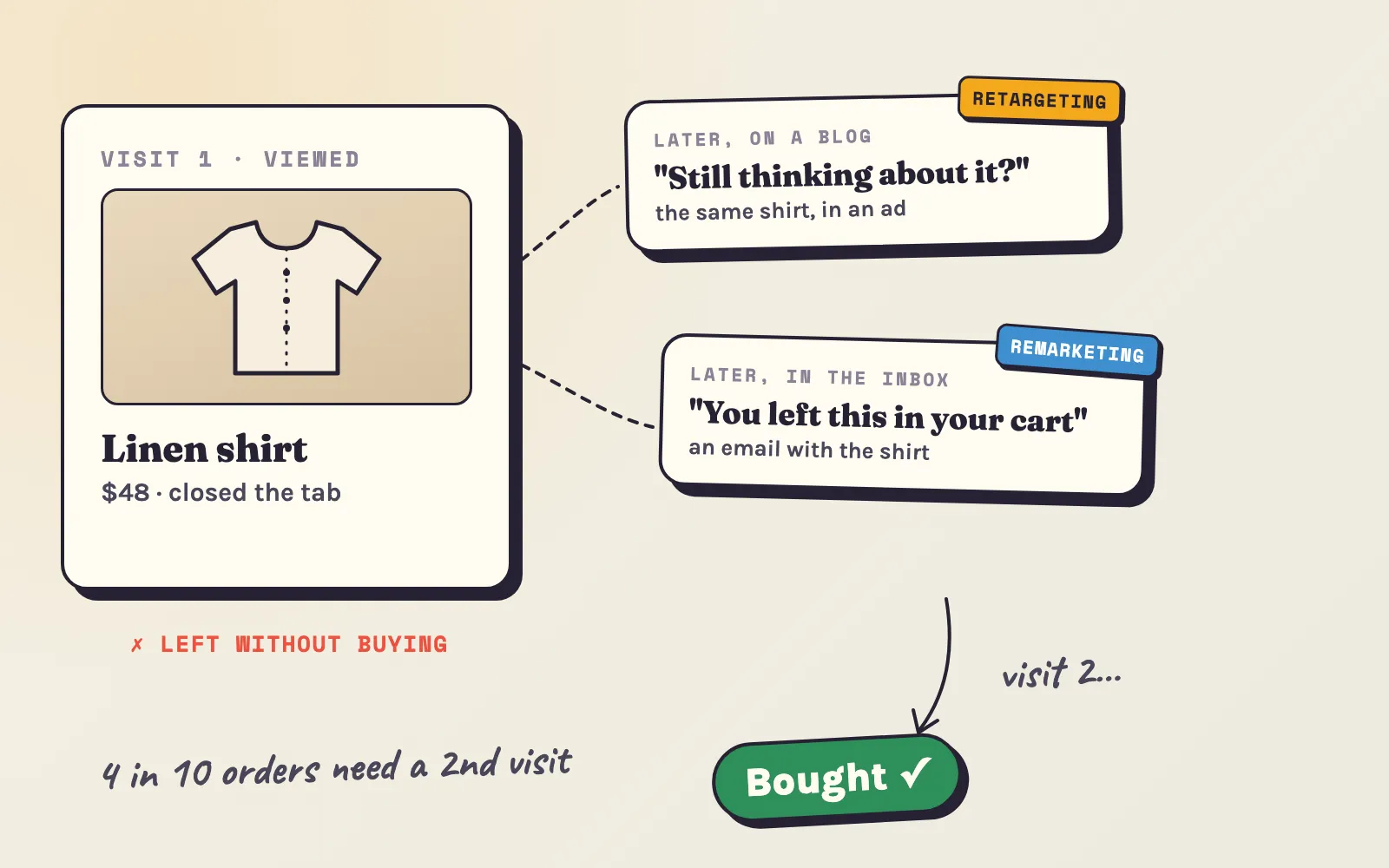
Good for: closing the sale. On Black Friday every shopper has a dozen tabs open - the same kind of product from several stores, deal sites, comparison articles. Most leave your store to compare. Whoever reminds them at the moment they decide often gets the order.
Our data shows how much research happens before the big days: in the two weeks before Black Friday 2025, 55% of orders came from shoppers who visited two or more times (median store), against 49% in a normal month.
How Adeagle helps: if your TikTok, Reels or Meta ads bring visitors who don’t buy, Adeagle’s retargeting shows each of them the products they looked at - while they read blogs, compare products, browse other Shopify stores and use shopping apps. Retargeting ads are clicked 6 to 12 times more often than ads to new shoppers, and Adeagle counts the sales that come from clicks and from views. Retargeting is part of the Professional and Ultimate plans; on any paid plan, Adeagle also shows your products to new shoppers on stores, blogs and apps that match your products.
How to do it:
- Install Adeagle now, not on the Friday - the retargeting audience fills up with your November visitors, so on Black Friday you can reach everyone who looked at your store in the weeks before.
- Pick the products you put on sale, so the ads show the deal price.
- Keep it on through December - gift shoppers decide late, and your last order date is a reason to come back.
More on how to plan it: retargeting vs remarketing.
11. Meta: keep it, cap it, don’t trust one report
Keep your two or three best ads running, set a daily cap you are comfortable losing on a bad day, and judge Meta by your Shopify orders and your total sales divided by total ad spend - not by Ads Manager alone. Read why Meta ads stop converting in 2026 for what changed and how to check it.
Your Black Friday timeline
- Prepare. Check your discount with the calculator, grow the email list with an early-access pop-up, install retargeting, connect Google's free listings, invite affiliates, start TikTok slideshows.
- The quiet weeks. Sales often dip as shoppers wait. Post daily, make your AI videos, send the teaser, add the Google promotion.
- Warm-up. Early access for subscribers, affiliates start posting, retargeting shows your offer to everyone who visited in November.
- Black Friday to Cyber Monday. Launch on Friday morning, remind on Saturday - nearly as big as Friday - and close on Monday night.
- Gift shoppers. Email and retarget with your last order date for Christmas; promote gift cards after it.
- The second order. Bring Black Friday's first-time buyers back with a reorder or cross-sell.
Your channel mix by budget
| Budget for November | Where to put it |
|---|---|
| $0 | Email to your list, TikTok slideshows daily, Google free listings and a promotion, affiliates on commission, one SEO gift page. |
| $300 | All of the above, plus AI video for 5-10 ads, retargeting through the whole period, and a capped Meta budget for your best ad. |
| $1,500 | All of the above, plus Shop Campaigns at a cost per customer your margin allows, Meta and TikTok ads on your best creatives, and a small ChatGPT ads test. |
Free tools to plan it
- Black Friday discount calculator - above, on this page.
- ROAS calculator - the return your ads need at your margin.
- CPA calculator - the most one order may cost you in ads.
- CPC calculator - what a visitor may cost, and what your budget buys.
- Customer lifetime value calculator - what a Black Friday buyer is worth if they come back.
Black Friday rewards the stores that prepared, not the ones with the biggest discount. Pick three or four channels from this list, set them up in the next two weeks, and give every shopper who visits a reason to come back.
Sources: Adeagle data on Black Friday 2025 orders and visits (a sample of 33 Shopify stores) and on retargeting; Shopify BFCM 2025; Meta changes and prices - our Meta guide, Leadenforce; TikTok formats - Fanpage Karma, Buffer, Metricool; AI video - Higgsfield; ad libraries - GetHookd comparison; email - Shopify Email pricing, Gmail and Yahoo sender rules; Google deals - Search Engine Land; Shop Campaigns; Shopify Collabs; ChatGPT ads - Similarweb, OtterlyAI, Search Engine Journal.
Questions
Six weeks before is ideal, but early November still works. Use the first two weeks to fix the store, grow your email list and build retargeting audiences, the week before for teasers and early access, and keep Cyber Monday and the December shipping deadlines in the plan.
One your margin can afford. Work out how many more orders the discount needs to keep your profit - at a 50% margin, 20% off needs 1.67 times the orders and 30% off needs 2.5 times. A typical store sold about 1.76 times its normal orders on Black Friday 2025, so many stores do better with bundles, a gift with purchase or a free-shipping threshold than with a deep percentage.
Email your list (Shopify Email is free up to 10,000 emails a month), post TikTok slideshows and short videos, add your deal to Google's free listings, offer creators a commission through an affiliate program, and spend the little paid budget you have on retargeting the shoppers who already visited.
Yes, but don't depend on them. Meta changed how it counts sales and matches ads through 2026, its ads cost about 12% more than a year ago, and prices peak in late November. Keep your best ads running with a capped budget and put the rest into channels you control or pay only for results.
They are the cheapest way to test ideas - a phone and a free editor are enough. One 2025 study found photo carousels got far more engagement than videos on TikTok, while larger 2026 studies found videos still get more views. Post both, and use slideshows for gift lists and comparisons.
Only as a small test. ChatGPT shows ads for many shopping questions, but early advertisers report mixed results - some good returns, some expensive clicks. If you sell giftable products, a small budget during the holiday weeks can show you whether it brings new customers.
Connect your store to Google Merchant Center with Shopify's Google & YouTube app, set the sale price in your products, and add a promotion in Merchant Center about a week before Black Friday. Products with a sale or a promotion can get a deal badge and appear in Google's deals results.
Keep going - December brings gift shoppers until the shipping deadline. Retarget November visitors with your last order dates, email gift ideas, and in January bring Black Friday's first-time buyers back for a second order.