
Ask ten dropshippers where to advertise and you get ten channels. Facebook. No, TikTok. No, Google Shopping is the only thing that works now. They are all right - for their product, at their margin. A channel that prints money for a $90 posture corrector can sink a $25 phone stand.
This guide starts where the others stop: with the math that tells you which channels your product can afford. Then it goes through each channel with real costs, shows when to stop a test, and ends with the sale most dropshippers never get - the shopper who comes back.
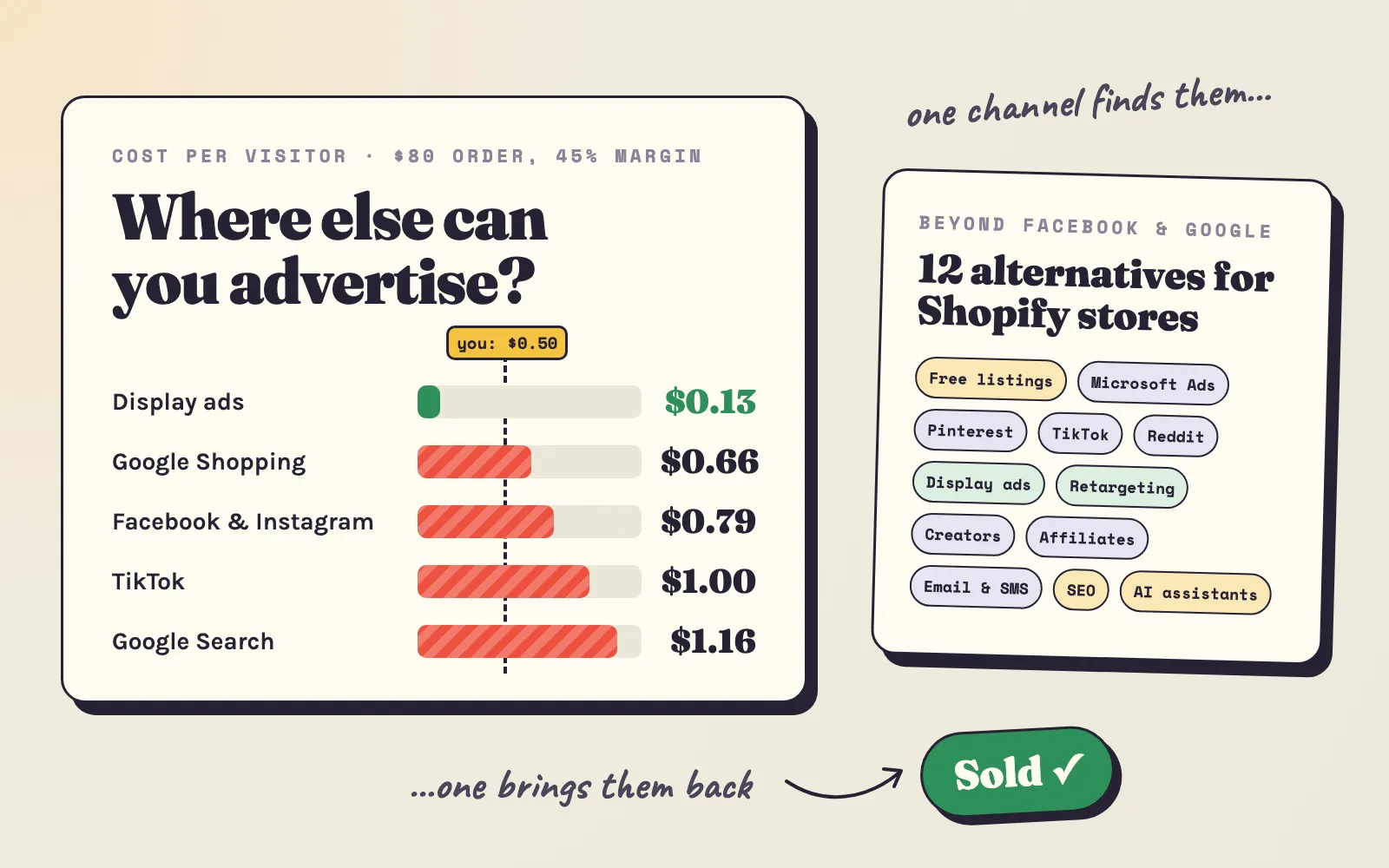
- Facebook and Instagram adsFind buyers for a new product. About $0.60-1.40 per visitor. Best for testing.
- TikTok adsProducts with a "wow" moment on camera. Cheap views, fewer clicks, needs new videos weekly.
- Google ShoppingPeople who already search for the product. About $0.66 per visitor. Needs a clean store and feed.
- Pinterest adsHome, fashion, beauty, gifts. Often $0.20-1.50 per visitor, slow but lasting.
- Display ads on related sitesThe cheapest visitors - about $0.13 on Adeagle's Essential plan - on stores, blogs and apps about your niche.
- Retargeting and emailBring back the visitors who didn't buy. The cheapest sale you will make.
- The ruleUse one channel to find buyers and one to bring them back. Pick both from the price you can pay per visitor - next section.
Start with your margin, not the channel
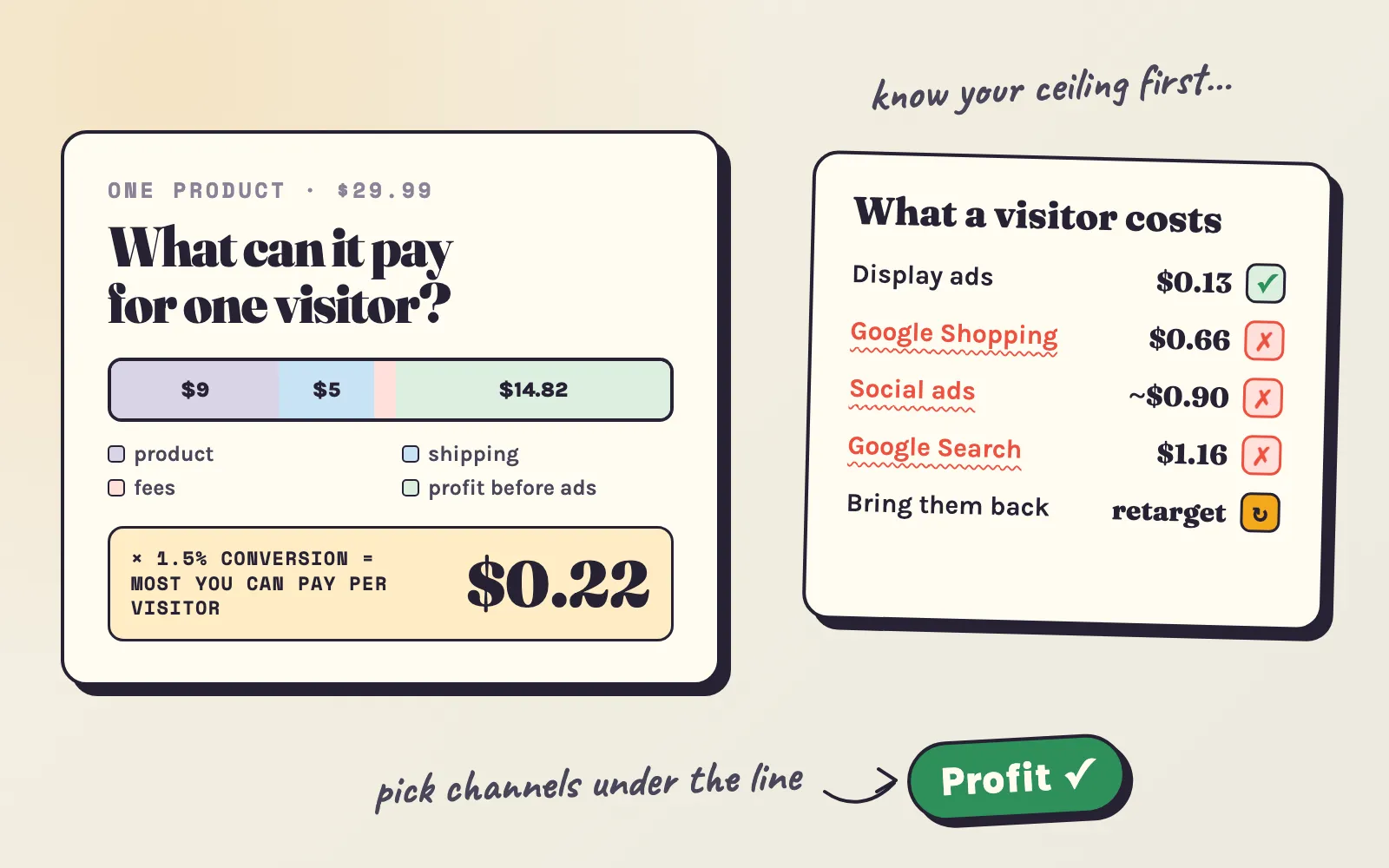
Every ad channel sells you visitors. The only question is whether your product can pay for them. One number answers it - the most you can pay for a visitor, your ceiling:
Profit per order is the price minus product cost, shipping, duties and payment fees - before ads. Conversion rate is the share of visitors who buy.
A typical dropshipping product, worked through:
Now compare that line with what visitors cost:
| Price | Profit before ads | Ceiling at 1% conversion | at 1.5% | at 2.5% |
|---|---|---|---|---|
| $29.99 | $14.82 | $0.15 | $0.22 | $0.37 |
| $49.99 | $26.24 | $0.26 | $0.39 | $0.66 |
| $79.99 | $44.37 | $0.44 | $0.67 | $1.11 |
What this means: a $30 product cannot pay $0.80 per visitor on social ads unless it converts at about 5% - which only exceptional products and creatives do. Cheap products need cheap visitors, a very high conversion rate, or a higher order value. That is why the best dropshipping stores sell bundles (“buy 2, get 1 free”) and upsells: a bigger order raises the profit per order - and with it the ceiling - without touching the ad.
The channels, one by one
Facebook and Instagram ads
Best for: testing new products and finding buyers you can’t target by keyword. Meta’s automated campaigns find buyers well once they have some sales to learn from.
What it costs: about $0.60-1.40 per click and $13-15 per 1,000 views for ecommerce in 2026, and Meta’s average price per ad rose about 12% a year (benchmark roundup).
What works: short videos that show the problem and the product solving it in the first three seconds; three to five different creatives per product; broad audiences instead of stacked interests; a landing page that matches the ad.
Watch out: slow delivery. Meta surveys people who buy from ads, and advertisers with a lot of negative feedback - often about shipping - get their ads shown less and can in the end lose the right to advertise (Meta). If a parcel takes two to three weeks, say so on the product page. Read more on why Meta ads stop converting in 2026.
TikTok ads
Best for: products with a visual “wow” - gadgets, beauty, kitchen, pets - and stores that can make new videos every week.
What it costs: views are often cheaper than on Meta, but fewer people click: one panel of 5,900+ brands reports a median of $4.08 per 1,000 views and a 0.61% click rate (TopGrowth / Triple Whale data), while Triple Whale’s own 2025 report puts the median at about $13 (Triple Whale). Plan on roughly $1 per visitor until your own numbers say otherwise.
What works: videos that look like a real person’s post, not an ad - filmed on a phone, natural light, a hook in the first second. Creator videos boosted as ads (Spark Ads) usually beat brand videos.
Watch out: creative fatigue. A TikTok video often wears out within one to two weeks, so plan two to three new clips a week per product.
Google Shopping and Search
Best for: products people already search for by name - “magnetic phone mount”, “dog hair remover” - and stores ready to compete on price and delivery.
What it costs: about $0.66 per click on Shopping and about $1.16 on Search for ecommerce (Scube Marketing, WordStream data). Shopping clicks often convert better, because the shopper saw the price and the photo before clicking.
What works: product titles written the way people search, sharp photos on a white background, a competitive total price, and starting with your one best seller. Free listings through Shopify’s Google & YouTube app come first - they cost nothing.
Watch out: Merchant Center suspensions for “misrepresentation”. Google does not ban dropshipping, but it suspends stores whose details don’t add up: no business address or phone, vague returns, prices or shipping that differ between the feed and the store. Fix all of that before you apply - each failed appeal makes the next one wait longer.
Pinterest ads
Best for: home decor, fashion, beauty, weddings, gifts - things people plan and save.
What it costs: ecommerce reports range from about $0.20 to $1.50 per click and $2-5 per 1,000 views (Tailwind).
What works: vertical images that show the product styled in a room or an outfit, with a short text overlay. Pins keep bringing visitors for months.
Watch out: Pinterest buyers plan ahead. Judge it on a 30-day window, not the first week.
Display ads and retargeting on related sites
Best for: cheap, relevant visitors and - above all - bringing back the shoppers who looked and left.
What it costs: on Adeagle about $0.13 per visitor on the Essential plan and $0.30 across all plans, counting only real visitors (August-September 2026). That is under the ceiling of most dropshipping products in the table above.
How it works: Adeagle shows your products as ads on other Shopify stores, blogs and apps about your niche - you choose the product categories and shopper interests, so a pet product appears on pet sites, not anywhere a view is cheap. On the Professional plan, retargeting shows each visitor the products they looked at in your store. In our data, retargeting ads are clicked 6 to 12 times more often than ads to new shoppers.
Watch out: display ads start the journey more often than they close it on the first click. Judge them on orders over two to four weeks, not on the first day.
Influencers and creator content
Best for: new stores without reviews, and stores that need fresh videos for their ads.
What works: send the product to 20-40 small creators (5,000-20,000 followers) whose audience is your buyer, ask for an honest post, and ask permission to use their video in your ads. One good creator clip can power your ads for weeks.
Watch out: follower counts lie. Pick creators by who comments on their posts, not by how many follow them.
Free channels
No budget yet? Post one short video of the product in use every day on TikTok, Reels and Shorts; list your products free on Google; pin them on Pinterest; and join an ad exchange with other stores (Adeagle’s free plan shows your products in partner stores in return for showing theirs in yours). Free traffic is slow - use it to learn which product people react to, then put money behind that one. More free tactics are in no sales on Shopify.
What sinks dropshipping ads
Most dropshipping ads don’t fail because of the ad. They fail because of something the ad exposes:
- Slow shipping. Twenty days was normal once; now it costs you buyers, refunds, and ad feedback scores. State delivery times on the product page, and move your best seller to a warehouse in your main market as soon as it sells.
- New duties. Since the US ended duty-free entry for small parcels on August 29, 2025, a product shipped from abroad can carry duties that eat the whole margin. Recalculate your profit per order with them.
- A store that looks temporary. No About page, no address, a generic name, policies copied from a template. Ads send people to it; doubt sends them away.
- A saturated product. If twenty stores and three marketplaces sell the same item, the cheapest one wins. Add a bundle, a better photo set or a reason to buy from you.
- Changing everything every day. Each change restarts the ad system’s learning. Change one thing at a time and wait a few days.
How to test a product without burning money
1. Set the budget from your margin. Plan about three times your break-even cost per order per product: about $45 for the $29.99 product above. Test three products with three to five creatives each, not fifteen products with one.
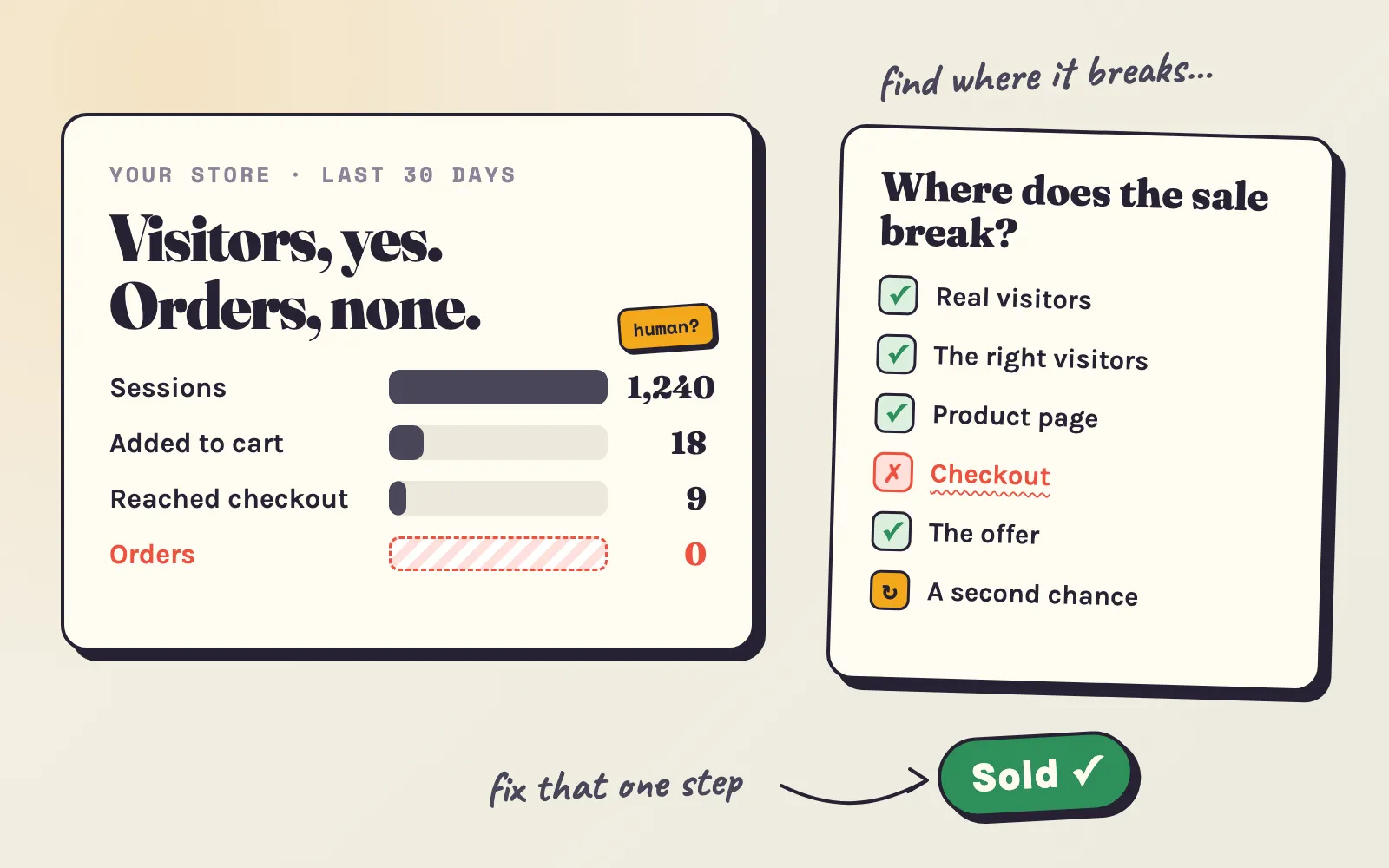
2. Read the numbers in order. Each step tells you what to fix:
3. Stop by the math, not by the mood. Sales come in randomly, so a good ad can go a while without one. But not forever:
The sale most dropshippers lose: the second visit
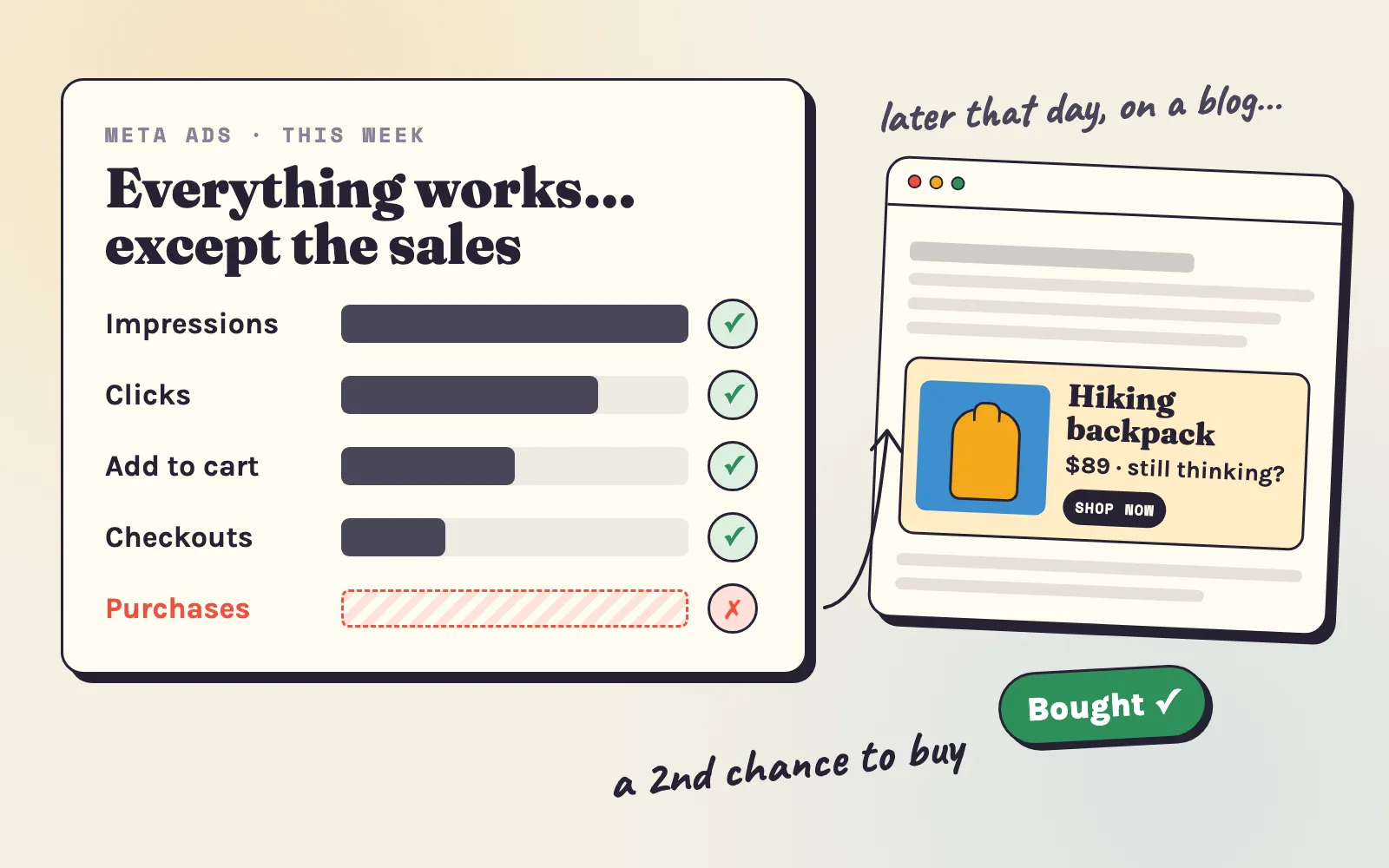
The dropshipping playbook assumes impulse buying: see the video, buy the thing. Our data says otherwise. In Shopify’s record of each order’s visits, even cheap orders often came after more than one visit:
More than 4 in 10 orders under $30 came from a shopper who visited at least twice. A dropshipper who only pays to find new visitors - and never brings anyone back - leaves those sales to whoever reaches the shopper next. Three ways to reach them again:
- Retargeting ads. Show visitors the product they viewed, later, on other sites they visit. On Adeagle, retargeting runs on related stores, blogs and apps, at a cost per visitor far under most dropshipping ceilings. Social retargeting works too, at social prices.
- Email from the first visit. A pop-up with a small first-order discount, a welcome email with the bestseller, and the abandoned checkout email Shopify sends for free.
- A reason to come back now. A bundle offer, a restock note, a “back in stock” alert - give the second visit a push.
A 14-day launch plan
| Days | $0 | $300 | $1,000 |
|---|---|---|---|
| 1-3 | Calculate your ceiling per product. Fix delivery times, policies, About page. | The same. Pick 3 products whose ceiling is above $0.20. | The same. Pick 3-5 products. |
| 4-7 | One video a day per product; free Google listings; join the ad exchange. | Social ads: 3 creatives × 3 products, about $45 each. Display ads on related sites from $29. | Social ads: 4-5 creatives × 3-5 products. Google Shopping on your best seller. |
| 8-10 | Keep the product people react to; drop the rest. | Stop ads that spent 2× break-even without a sale. Move budget to what sold. | The same, plus a bundle offer on the winner. |
| 11-14 | Email pop-up and abandoned checkout email on. | Retargeting for visitors who didn’t buy; email on. | Retargeting on; creator videos for the winner; scale slowly - 20-30% more a week. |
Free tools to plan it
- CPC calculator - “Find the most I can pay” gives your ceiling per visitor.
- ROAS calculator - your break-even ROAS from price and costs.
- CPA calculator - what one order may cost you in ads.
- CPM calculator - what 1,000 views cost, and what your budget buys.
- Customer lifetime value calculator - how much more you can pay for a buyer who comes back.
The best channel for your dropshipping store is not the one with the loudest fans. It is the one whose price per visitor sits under your ceiling - plus one that brings back the shoppers who almost bought.
Sources: Facebook and Instagram costs - WordStream, Triple Whale and Meta earnings via Coupler; Meta customer feedback - Meta; TikTok - Triple Whale and TopGrowth; Google Shopping and Search - Scube Marketing; Pinterest - Tailwind; US duties - Cole International on the end of de minimis; Adeagle data on cost per visitor, retargeting clicks and visits per order (a sample of Shopify stores, 2026).
Questions
The ones your margin can pay for. Facebook and Instagram ads are best for testing new products, TikTok for products that show well in a short video, Google Shopping for things people already search for, Pinterest for home, fashion and gifts, and display ads with retargeting for cheap visitors and for bringing back shoppers who left. Work out the most you can pay per visitor first, then pick the channels under that line.
Plan about three times your break-even cost per order for each product you test - roughly $45 for a $29.99 product with a $15 profit. A test of three products with a few creatives each needs $150-300. Spend more only on the product and creative that reach break-even.
Enough to test, not to scale. $500 tests three to five products properly if the products leave $15-30 profit per order. It is not enough to learn anything if you spread it over fifteen products or change the ads every day.
Yes for finding buyers, but they cost more than before - Meta's average price per ad rose about 12% a year in 2026 - and a cheap product often cannot pay for a social ad click. Use them to test and find buyers, and close the sale with cheaper channels such as retargeting and email.
TikTok views are often cheaper, but fewer people click, and it needs new videos all the time. Facebook and Instagram give more control and steadier results. Start where your product shows best - a product with a "wow" moment on camera suits TikTok; a product people need to read about suits Facebook.
Yes. Google does not ban dropshipping, but Merchant Center suspends stores whose business details, prices, shipping or return policies don't match between the feed and the website. Show your real delivery times, a contact address and clear policies before you apply.
When it has spent about twice your break-even cost per order with no sale. If the click-through rate is far below normal after a few thousand impressions, change the creative first - the product may be fine.
Post short videos of the product in use every day, list your products free on Google with the Google & YouTube app, pin them on Pinterest, and join an ad exchange with other stores. Free traffic is slow, so use it to learn which product people react to before you pay for ads.